NSW Hot Water System Rebates Explained: Heat Pump, Solar, Electric & Gas
Maybe your old electric tank has started rumbling, or you’ve opened a power bill and wondered why hot water costs so much. Either way, you’ve probably heard there’s a hot water system rebate in NSW and want to know what you’d actually get.
The short version: Sydney homeowners can stack two government discounts on an eligible heat pump or solar hot water system, and there’s now a zero-interest loan to cover what’s left. But the rules are specific. The type of system you’re replacing, the model you choose and who installs it all decide what you can claim. Some of what you’ll read online is also out of date, because NSW changed its scheme rules on 1 July 2026.
This guide explains each scheme in plain English, what each type of system qualifies for, and how to make sure the discount actually shows up on your quote.
Every NSW Hot Water Rebate at a Glance
Scheme
Who runs it
What qualifies
How you get it
Small-scale Technology Certificates (STCs)
Australian Government (Clean Energy Regulator)
Heat pump and solar water heaters on the national register, in new or existing homes
A discount on your installer’s quote
Hot Water Upgrade Incentive (Energy Savings Scheme)
NSW Government
Replacing an existing electric or gas water heater with an eligible heat pump or solar system
A discount on the quote from an accredited provider
Home Energy Saver
NSW Government
Heat pump and electric-boosted solar water heaters, among other upgrades
A zero-interest loan of up to $15,000, plus discounts for some households
New gas or standard electric system
–
Not eligible for any of the above
No rebate
The big takeaway: rebates are paid for switching to a heat pump or solar system, not for buying another gas or standard electric tank.
The NSW Government Hot Water System Rebate (Energy Savings Scheme)
The main NSW hot water system rebate is called the Hot Water Upgrade Incentive. It runs through the state’s Energy Savings Scheme, which rewards upgrades that cut energy use.
How it works
You don’t fill in a form or wait for money in your bank account. When an accredited provider installs an eligible heat pump or solar water heater, they create Energy Savings Certificates based on how much energy your new system will save. They sell those certificates and pass the value on to you as a discount on your quote.
That means two things matter:
The installer has to be part of the scheme. Only accredited certificate providers (or installers working with one) can create the certificates. An ordinary quote from a company that isn’t involved won’t include the discount.
The discount happens at the time of the job. You can’t install a system first and claim the NSW incentive later.
Who can get it
All NSW households and small businesses may be eligible, and it isn’t income-tested. The main conditions are:
You’re replacing an existing electric or gas water heater
The new system is an eligible heat pump or solar water heater
A heat pump comes with at least a 5-year warranty against defects, as the NSW Government advises
The installation meets Australian Standards and the plumbing code
You generally won’t qualify if you’re building a new home with no existing water heater, or if you’re swapping an existing heat pump or solar system for a newer one. The incentive is based on the energy you’ll save, so replacing an already efficient system doesn’t earn much, if anything.
How much is it worth?
There’s no single fixed amount. The value depends on the model you choose, the system you’re replacing, where you live and the market price of certificates on the day. As a guide, the NSW Government has quoted a typical incentive of roughly $400 to $675 for replacing an electric water heater with a heat pump. Replacing a gas water heater earns less, because the energy saving counted by the scheme is smaller.
You’ll also need to pay a minimum amount towards the system and installation yourself. The scheme rules don’t allow a fully “free” upgrade.
What changed in July 2026
New scheme rules started on 1 July 2026. The headline change was the removal of the Peak Demand Reduction Scheme’s heat pump water heater activity. That activity had been suspended since December 2024 and applied to large commercial systems, so it doesn’t change much for a typical Sydney home. The household Hot Water Upgrade Incentive under the Energy Savings Scheme is still available, with no closing date announced.
If an article or salesperson quotes you a separate “peak demand” heat pump rebate on top, check how current their information is.
The Federal Hot Water System Government Rebate (STCs)
The second hot water system government rebate in NSW comes from Canberra, not Macquarie Street. Under the Small-scale Renewable Energy Scheme, eligible solar and heat pump water heaters earn Small-scale Technology Certificates (STCs).
How STCs work
Your system must be a model listed on the Clean Energy Regulator’s register of solar water heaters and heat pumps.
Heat pumps must be no bigger than 425 litres.
The number of STCs depends on the model’s efficiency, your postcode’s climate zone and the year it’s installed.
You sign an assignment form that hands the certificates to your installer or their agent, and they take the value off your quote.
Unlike the NSW incentive, STCs also apply to new homes, and you don’t need to be replacing an old system.
How much STCs are worth
STC prices move with the market. Through 2026 they’ve traded at around $37 to $40 each, and the government’s clearing house pays a fixed $40 (excluding GST), although sales there can be slow. A typical household heat pump earns somewhere in the teens of certificates, so the discount is usually several hundred dollars.
The important bit is timing. The scheme ends in 2030, and the number of certificates each system can earn drops every year until then. The same heat pump installed next year will generally attract a smaller federal discount than it would this year.
Heat Pump Hot Water System Rebate NSW
Heat pumps get the best deal. An eligible model can attract both the federal STC discount and the NSW incentive, and it’s the main system covered by the Home Energy Saver loan.
A heat pump works like a reverse-cycle air conditioner running backwards. A fan draws in outside air, a refrigerant picks up its warmth, and a compressor moves that heat into the water tank. Because it’s moving heat rather than making it, the NSW Government says a heat pump can cut hot water energy use by up to 75% compared with a standard electric tank.
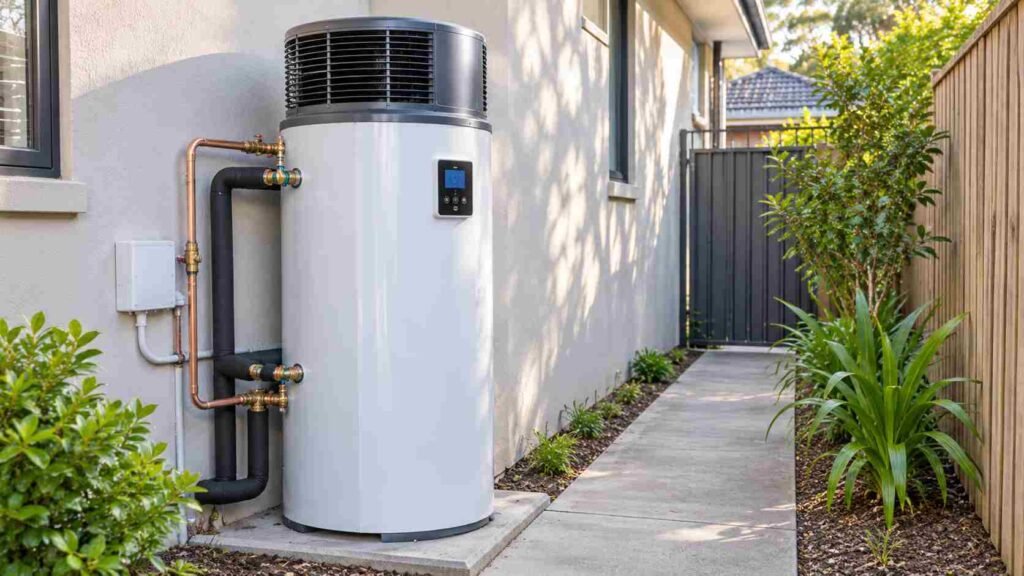
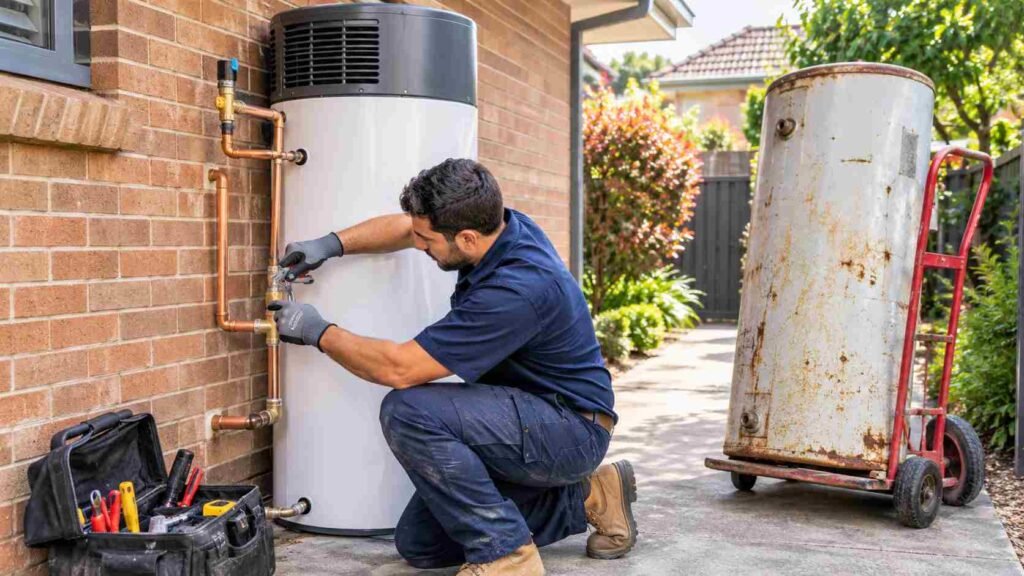
Heat pump hot water system installed beside a Sydney home, eligible for the NSW rebate
What to check before you choose a heat pump
Space and airflow. Most household heat pumps sit outside, with room around them for air to move. A cramped side passage or enclosed cupboard can hurt performance.
Noise and neighbours. Under NSW noise rules, a heat pump water heater shouldn’t be heard inside a neighbour’s bedroom or living room from 10pm to 7am on weekdays, or 10pm to 8am on weekends and public holidays. Place it away from their windows and set it to heat during the day.
Rooftop solar. If you have solar panels, a timer that runs the heat pump in the middle of the day lets you heat water with your own power.
Tank size. Match it to your household. Too small and you’ll run out; too big and you’re heating water you don’t use.
Strata approval. In a unit or townhouse, check your by-laws before you book anything.
Our hot water systems team can look at your site and tell you whether a heat pump will work well there before you commit.
Solar Hot Water System Rebate NSW
Solar water heaters are the other system type the rebates are built for. An eligible solar hot water system can earn STCs and, when it replaces an existing electric or gas water heater, the NSW incentive as well. Electric-boosted solar water heaters are also on the Home Energy Saver list.
A few things to know:
Your roof matters. Collectors need a mostly unshaded, roughly north-facing roof to do their job.
Frost-prone suburbs need the right collectors. In colder pockets of Western Sydney and the Blue Mountains, ask about frost protection.
Booster type. Most solar systems have an electric or gas booster for cloudy days. Check with your installer which version qualifies for each scheme.
Replacing old solar with new solar generally won’t earn the NSW incentive, although the new system may still attract STCs.
This is where people often get caught out. There’s no rebate for installing a new standard electric storage tank. Those tanks heat water with an element, much like a kettle, and they aren’t eligible for STCs or the NSW incentive.
The good news is the reverse: if you already have an old electric tank, you’re in the best position to claim. Replacing an electric water heater with a heat pump attracts the biggest NSW incentive, because that’s where the energy saving is greatest. Electric storage tanks are also often one of the biggest energy users in a home, so the running-cost difference is real. Our tips for cutting your hot water bill show what else you can do in the meantime.
Gas Hot Water System Rebate NSW
There’s currently no federal or NSW household rebate for installing a new gas hot water system, whether it’s a storage tank or a continuous flow unit. Gas systems have never qualified for STCs, and the NSW household incentive only covers heat pump and solar upgrades.
If you have gas hot water now, you can still use the NSW hot water system rebate to switch to a heat pump. The discount is smaller than for replacing electric, but you may also qualify for STCs and the Home Energy Saver loan. If you go fully electric, ask your retailer about closing your gas account so you stop paying the daily supply charge.
Staying with gas? That’s fine too, and we still install and repair gas systems. Just make sure the work is done by a licensed gasfitter, and if you ever smell gas near your unit, call for gas leak detection and repair straight away.
Home Energy Saver: Zero-Interest Loans and Discounts
Even after rebates, a heat pump is a bigger upfront cost than a basic electric tank. That’s the gap the NSW Government’s Home Energy Saver program is designed to fill.
Loan amount: up to $15,000 at 0% interest, with no establishment fees
Repayment term: up to 10 years
Who can apply: NSW homeowners and landlords with a combined household taxable income of up to $210,000
What it covers: heat pump water heaters and electric-boosted solar water heaters, plus other upgrades such as rooftop solar, batteries and reverse-cycle air conditioning
How you apply: through an approved finance provider and installer, not directly through a government website
The program also includes discounts of up to $4,000 for eligible households. Eligibility for those is narrower, so check the current details on the NSW Government site before counting on one.
The loan isn’t a rebate, but it can be used alongside the STC and NSW discounts. You take the rebates off the price first, then finance what’s left.
Renters, Landlords and Apartments
Renting? The hot water system belongs to your landlord, so the upgrade and any NSW rebate for the hot water system are their call. STCs can only be claimed by the system’s owner. If your current system is old and costly to run, it’s worth raising with your landlord or agent, especially as landlords can also apply for the Home Energy Saver loan.
Landlords can claim the same STC and NSW discounts as owner-occupiers. A more efficient system can also mean fewer breakdowns, and in NSW a hot water failure counts as an urgent repair you have to deal with quickly.
Apartments and townhouses come with extra questions: where the outdoor unit can go, whether there’s enough airflow, and what strata needs to approve. Some buildings have a central hot water plant, which is a separate matter for the owners corporation.
How to Claim a Hot Water System Rebate in NSW, Step by Step
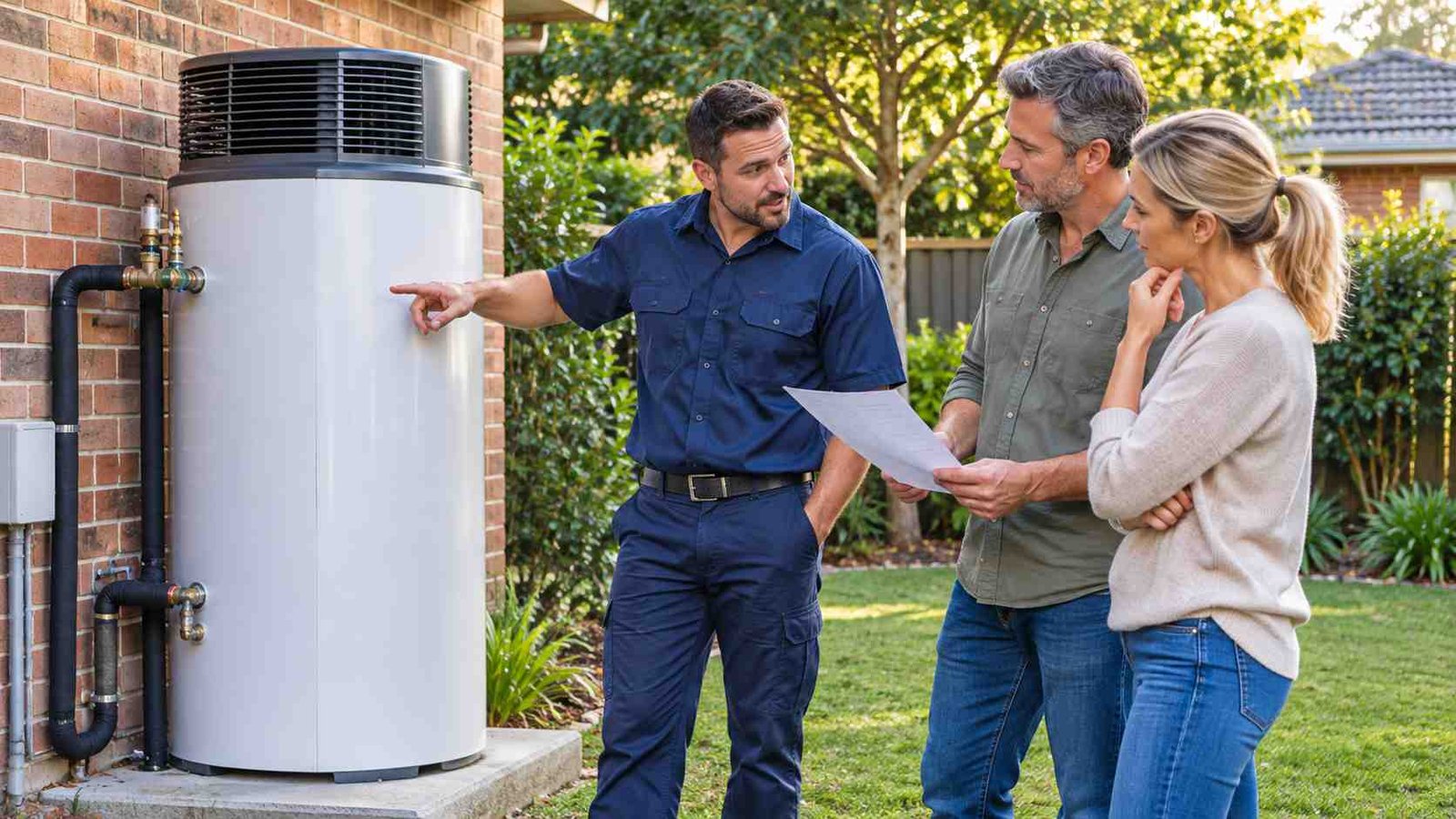
Plumber replacing an old electric tank with a heat pump to claim the NSW hot water rebate
Check what you have now. Note whether your current system is electric, gas, solar or heat pump, and its age from the sticker on the tank. This decides which discounts apply.
Choose an eligible model. It needs to be on the Clean Energy Regulator’s register for STCs and eligible under the NSW scheme for the state incentive. Ask your installer to confirm both in writing.
Get an itemised quote. It should show the full price, the STC discount, the NSW discount and what you pay. If the NSW discount isn’t listed, ask whether the installer is working with an accredited certificate provider.
Check the fine print. Look for the warranty on the tank and the heat pump unit, what happens to your old system, and whether electrical work is included.
Sign the forms. You’ll usually sign an STC assignment form and paperwork for the NSW scheme. Read them before you sign.
Have it installed properly. The plumbing must be done by a licensed plumber, and any new circuit or switchboard work by a licensed electrician.
Keep your paperwork. Hold on to your invoice, warranty details and compliance certificates. You’ll need them for warranty claims or if you sell the house.
Red Flags When Someone Offers You a Rebate
Generous rebates attract some pushy selling. Watch out for:
“Free” hot water upgrades. The NSW scheme requires you to pay a minimum amount, so a $0 offer should make you ask questions.
Door-knockers and cold callers. The NSW Government has been moving to stop door-knocking for these upgrades. Never sign on your doorstep.
No written, itemised quote. You should be able to see exactly what the discounts are and what you’re paying.
Pressure to decide today. A real offer will still be there tomorrow.
Vague answers about the installer. Ask for the company’s licence number and which accredited provider they work with, then check both.
Very cheap units with short warranties. A heat pump that fails in three years is no bargain, even with a rebate.
Should You Upgrade Before Your Old System Dies?
Most people replace a hot water system when it breaks, usually on a cold morning with a full house. That’s the worst time to shop around. You need hot water today, and the simplest fix is often another tank like the old one, with no rebate at all.
Planning ahead gives you options. Consider upgrading early if:
Your system is around 10 years old or more. Many last about 8 to 12 years.
You’re seeing warning signs, like rusty water, rumbling noises, leaks around the base or hot water running out sooner. Our list of common water heater problems covers what to look for.
You’ve already had repairs and the bills are adding up.
You’ve recently added rooftop solar and want to use more of your own power.
The federal STC discount also shrinks each year until 2030, so waiting rarely makes the deal better.
If your system has already given up, don’t panic. Start with our guide to why a water heater stops producing hot water, and if you need help fast, our 24/7 emergency plumbers can make it safe and talk you through your options, including whether a rebated heat pump can go in quickly.
Hot Water System Rebate NSW FAQs
Do I have to apply for the rebate myself?
Usually not. Both the STC discount and the NSW incentive are applied by your installer or their accredited provider and taken off your quote. Your part is choosing an eligible system, using an installer who can access the schemes, and signing the forms.
Can I claim both the federal and NSW rebates?
Yes. An eligible heat pump or solar water heater that replaces an existing electric or gas system can get STCs and the NSW incentive on the same job. You can then use the Home Energy Saver loan for the remaining cost if you qualify.
Is the NSW hot water rebate means-tested?
The Hot Water Upgrade Incentive isn’t income-tested; all NSW households may be eligible. The Home Energy Saver loan does have an income limit of $210,000 combined taxable household income.
Can I get a rebate on a new build?
You can usually get STCs on a new home, as they don’t need an old system to be replaced. The NSW incentive generally doesn’t apply where there’s no existing electric or gas water heater.
Can I claim a rebate after the system is installed?
Not the NSW incentive. It has to be arranged through an accredited provider as part of the installation. STCs are also created by your installer or their agent around the time of the job, so sort out both before work starts.
When does the hot water system NSW rebate end?
The NSW Hot Water Upgrade Incentive currently has no closing date, although its value and rules can change. The federal STC scheme runs until the end of 2030, with the discount getting smaller each year.
Talk to Radiant Plumbing About Your Hot Water Upgrade
Rebates can take a real chunk off a new heat pump or solar system, but only if the right system goes in, in the right spot, with the paperwork done properly.
Radiant Plumbing Services installs and replaces heat pump, solar, gas and electric hot water systems across Greater Sydney. Our licensed and insured plumbers will look at your current setup and tell you straight which upgrade makes sense for your home and budget. Then we’ll give you a fixed, upfront quote that shows exactly what you’ll pay.
$0 call-out fee
Upfront, fixed quotes with no hidden fees
Licensed, insured plumbers across all Sydney suburbs