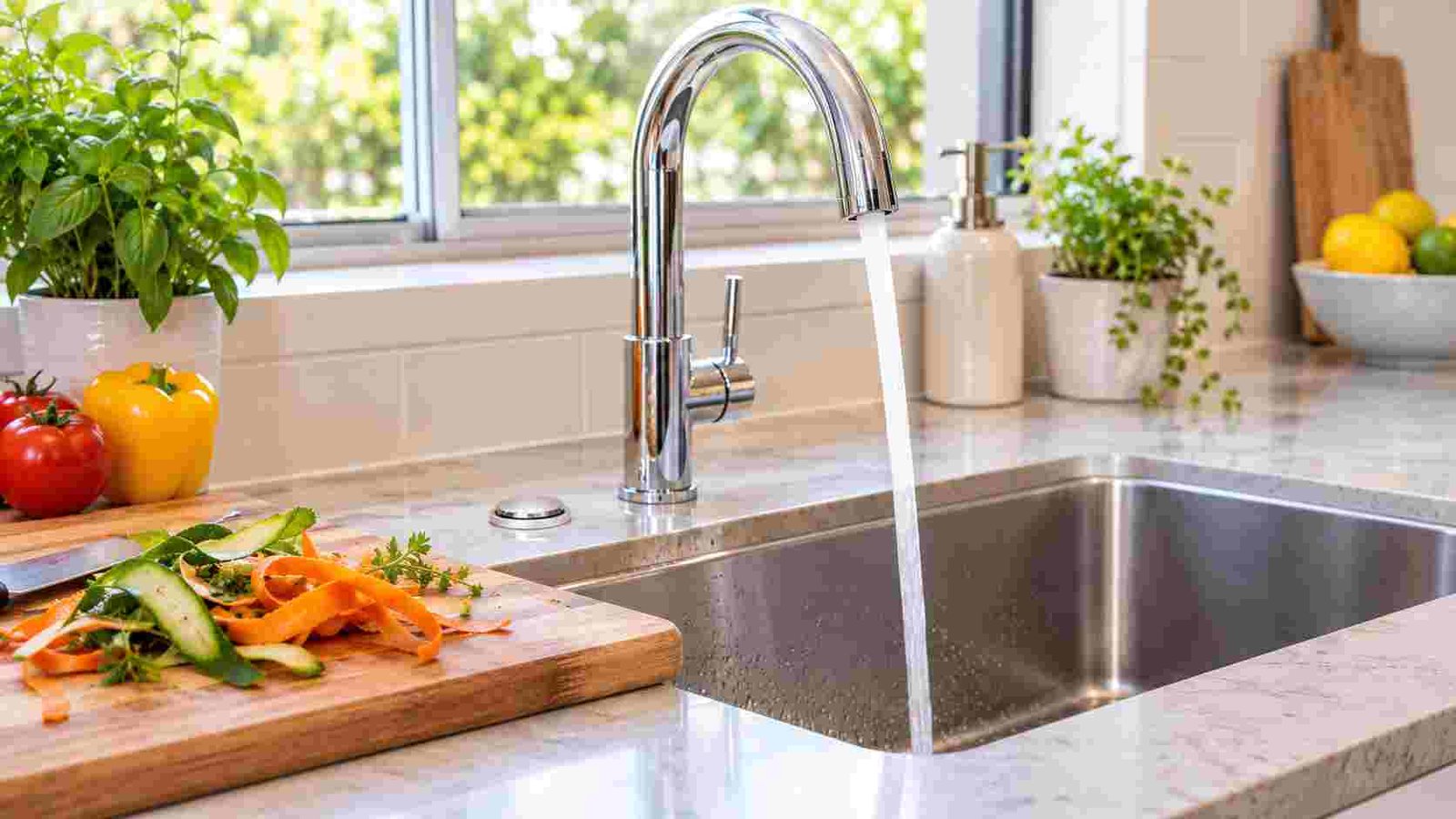
An InSinkErator is a food waste disposer that sits under your kitchen sink and grinds food scraps into fine particles that wash away through your drain. In Australia, the main models are the Model 46, Model 56, Model 66 and the Evolution series, which differ in motor power, grinding parts, noise and warranty. Installation needs a licensed plumber for the drainage and usually a licensed electrician for a power point under the sink. The cost depends on the model you choose and how much plumbing and electrical work your kitchen needs. Check your local water utility’s rules first, as some parts of Australia don’t allow food waste disposers at all.
Scraping dinner plates into the bin, tying off smelly bags and dragging bins out in summer heat are some of the least loved jobs in any kitchen. It’s no surprise that more Australian homeowners are asking about an InSinkErator garbage disposal, especially during a kitchen renovation.
But a food waste disposer isn’t right for every home. It needs the right plumbing setup, a power supply under the sink, and a water utility that allows it. It also changes what you can and can’t put down your kitchen drain.
What Is an InSinkErator?
InSinkErator is a brand of food waste disposer, a small electric appliance fitted under the kitchen sink between the sink outlet and the drain. In Australia, the brand name is so well known that many people use “InSinkErator” to describe any garbage disposal unit, in the same way people say “Esky” for any cooler.
When you turn it on and run cold water, a spinning plate inside the unit flings food scraps against a stationary grinding ring. The food is ground into very fine particles, and the water carries them down your kitchen drain and into the sewer. InSinkErator units don’t use blades. They use spinning lugs and a grinding ring to break food down.
The main parts are:
- The sink flange: the metal ring that sits in your sink’s plug hole
- The mounting assembly: clamps the disposer to the underside of the sink
- The grinding chamber: where food is broken down
- The motor: an electric motor that spins the turntable
- The discharge outlet: the pipe that connects the unit to your sink trap and drain
- The switch: a wall switch, a power point switch or an air switch button that turns the unit on and off
Can You Install an InSinkErator Everywhere in Australia?
No, and this is the first thing to check. Rules on food waste disposers are set by each water utility, and they vary across the country.
- Western Australia: Water Corporation does not allow food waste disposal units to be installed on any facility that discharges to its wastewater system.
- Sydney: Sydney Water does not allow food waste disposal units in business premises such as cafes and restaurants, and asks customers to check with it before installing anything that connects to its systems.
- Other areas: Rules differ between utilities and councils, particularly for businesses and properties on septic systems.
Before you buy a unit, check with your local water utility, and if your home uses a septic tank or an on-site wastewater system, talk to your plumber and council about whether a disposer is suitable. A licensed plumber who regularly installs disposers in your area will know the local requirements.
InSinkErator Australia Models Compared
InSinkErator sells several models in Australia. The core range is the Model 46, Model 56 and Model 66, plus the premium Evolution 100 and Evolution 200. The table below compares the main features InSinkErator lists for each.
| Model | Motor | Grinding system | Switch | Warranty |
|---|---|---|---|---|
| Model 46 | 0.55 hp | 1-stage galvanised steel | Power point switch (air switch kit sold separately) | 2 years |
| Model 56 | 0.55 hp | 1-stage stainless steel | Built-in air switch | 3 years |
| Model 66 | 0.75 hp | 1-stage stainless steel | Built-in air switch | 4 years |
| Evolution 100 | See manufacturer specs | Multi-stage grinding | Built-in air switch | 5 years |
| Evolution 200 | See manufacturer specs | Multi-stage grinding | Built-in air switch | 6 years |
Specifications and warranties can change, so check the current details on InSinkErator’s website or the box before you buy.
InSinkErator 46
The InSinkErator 46 is the entry-level model. It has a 0.55 hp motor, a galvanised steel grinding system, basic sound reduction and a 2-year guarantee. It doesn’t come with a built-in air switch, so it’s usually turned on at a switched power point under the sink, or you can add an air switch kit. It suits smaller households with moderate use.
InSinkErator 56
The InSinkErator 56 is the mid-range option and one of the most popular choices in Australian homes. It has the same 0.55 hp motor size as the 46, but upgrades to stainless steel grind parts, a built-in air switch, a removable sound baffle and a 3-year guarantee. It’s a good fit for regular use in small to medium households.
InSinkErator 66
The InSinkErator 66 is the top of the standard range. It steps up to a 0.75 hp motor, has stainless steel grind parts, a built-in air switch, a stainless steel stopper and InSinkErator’s quietest sound reduction in the standard range, with a 4-year guarantee. It suits larger families and busy kitchens.
InSinkErator Evolution series
The InSinkErator Evolution range is the premium tier. Evolution models use multi-stage grinding, which breaks food down more finely before it leaves the unit, and have more advanced sound insulation. They come with a built-in air switch and longer warranties, with InSinkErator listing 5 years for the Evolution 100 and 6 years for the Evolution 200. They suit households that cook a lot, open-plan kitchens where noise matters, and buyers who want the longest warranty.
How the InSinkErator Air Switch Works
The InSinkErator air switch is a button mounted on your sink or benchtop. When you press it, it sends a pulse of air down a thin tube to a control box on the disposer, which turns the unit on or off. Because there are no electrical wires running to the button, it’s a safe way to switch the disposer near water.
The air switch is built into the Model 56, Model 66 and Evolution models. On the Model 46 it’s available as an add-on kit. Most installations need a hole in the sink or benchtop for the button. If you don’t want to drill into a stone benchtop, InSinkErator also sells an underbench air switch bracket that mounts the button inside the sink cupboard instead.
Common air switch problems
- The unit doesn’t start when you press the button: check that the air tube is firmly connected at both ends and isn’t kinked or crushed in the cupboard.
- The unit starts and stops randomly: the tube may be loose, cracked or pinched.
- Nothing happens at all: check that the power point is switched on and the disposer’s reset button hasn’t tripped.
InSinkErator Installation: What’s Involved
A professional InSinkErator installation usually involves both plumbing and electrical work.
The plumbing work
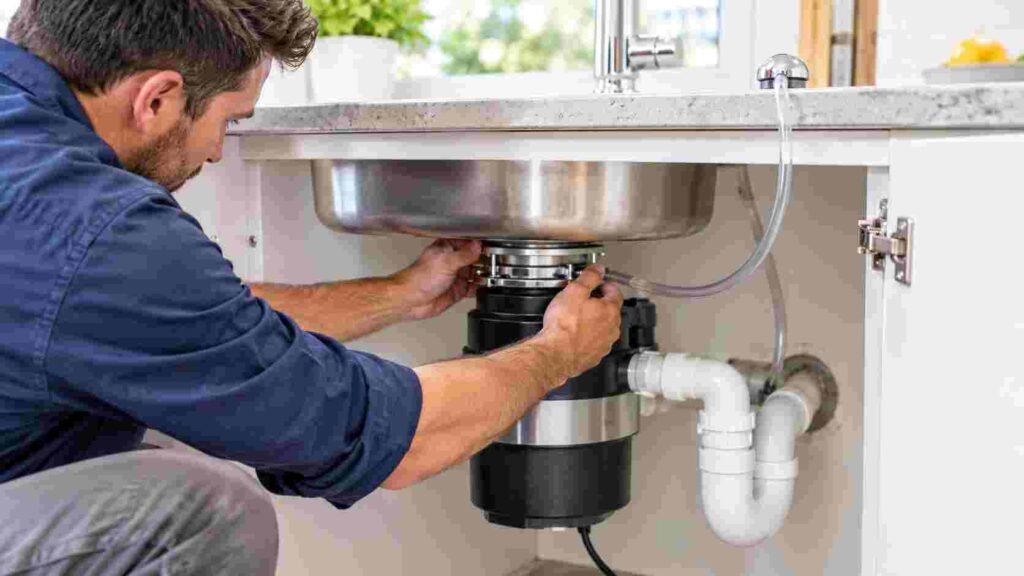
- Check the sink and space. The plumber checks your sink has a suitable outlet and that there’s enough room in the cupboard for the unit, the trap and any filters or bins.
- Fit the sink flange and mounting assembly. The flange is sealed into the sink outlet and the mounting ring fixed underneath.
- Mount the disposer. The unit locks onto the mounting ring.
- Connect the discharge. The disposer’s outlet connects to the sink trap and drain. The pipe may need to be modified so it falls correctly and the trap sits at the right height.
- Connect the dishwasher (if needed). If your dishwasher drains through the sink, the plumber sets up the dishwasher connection according to the manufacturer’s instructions for Australian installations.
- Test for leaks. The sink is filled and drained, and the unit run with water, to check every joint.
In NSW, connecting a disposer to your drainage is plumbing work, which must be done by a licensed plumber. You can check any tradesperson’s licence on the Service NSW licence check.
The electrical work
A disposer needs a power supply under the sink. The InSinkErator spec sheets list a switched power point (GPO) for models without an air switch. If your kitchen doesn’t already have a suitable power point in the sink cupboard, a licensed electrician needs to install one. Electrical work in NSW must be done by a licensed electrician.
How long does installation take?
Replacing an existing disposer with a similar model is usually a quick job, because the power and plumbing are already in place. A first-time installation takes longer, especially if the trap and drain need changing, a power point needs adding or an air switch hole needs drilling in a stone benchtop.
InSinkErator Installation Cost: What Affects the Price
We don’t publish a single price because every kitchen is different, but these are the factors that decide what an InSinkErator installation will cost:
| Factor | Lower cost | Higher cost |
|---|---|---|
| Model | Model 46 | Evolution 200 |
| Type of job | Replacing an existing disposer | First-time installation |
| Power supply | Power point already under the sink | New power point needed (electrician) |
| Air switch | Underbench bracket or existing hole | New hole drilled through a stone benchtop |
| Plumbing | Existing trap and drain suit the unit | Drain and trap need to be changed or lowered |
| Dishwasher | No dishwasher connection | Dishwasher connection needs reworking |
| Access | Clear, roomy sink cupboard | Tight cupboard or double-bowl sink layout |
| Timing | Done during a renovation | Retrofitted into a finished kitchen |
The most cost-effective time to install a disposer is during a kitchen renovation, when the plumber and electrician are already on site and the cabinets are open. Our kitchen renovation plumbing can include planning the sink, disposer, dishwasher and tap layout together.
Whatever the job, ask for a written, fixed quote that covers the unit (if supplied), plumbing, electrical work, the air switch and removing your old disposer.
InSinkErator Pros and Cons
The pros
- Less food in your bin. Australian households waste about 2.5 million tonnes of food a year, according to the Queensland food waste facts. A disposer means fewer food scraps sitting in your kitchen and outdoor bins.
- Fewer smells and pests. With less rotting food in the bin, there’s less to attract flies, ants and other pests, which helps in a hot Sydney summer.
- Convenience. Scrape plates straight into the sink while you wash up.
- Less food sent to landfill. Food waste that goes to landfill breaks down and produces greenhouse gases. Where a disposer sends food to a treatment plant that can recover energy, it can be a better outcome than landfill.
- Low running costs claimed by the manufacturer. InSinkErator says its units use less than 1% of household water use, and lists low yearly electricity use for models like the Model 56.
The cons
- Not allowed everywhere. Some water utilities, including in Western Australia, don’t allow them on domestic connections, and businesses face stricter rules.
- Up-front cost. You pay for the unit, plumbing and often electrical work.
- Uses water and electricity. The amounts are small, but they’re not zero.
- Not for everything. Fats, oils and grease, large bones, fibrous scraps in large amounts and non-food items can cause blockages or damage. Western Sydney University notes that fats, oils and grease are among the worst things to put down the sink.
- Noise. Even quieter models make noise while running, which matters in open-plan living areas.
- Septic systems. Extra food solids can affect septic tanks, so homes on septic need advice first.
- Council food scrap bins. If your council already collects food scraps in a green bin, a disposer is less of an advantage.
Is an InSinkErator worth it?
It’s worth it if you cook often, your water utility allows it, your kitchen has room under the sink, and you’ll use it the right way. It’s less worthwhile if you’re on a septic system, already have a council food scrap bin you’re happy with, or live in an area where disposers aren’t permitted. Australia has a national goal to halve food waste by 2030, as Green Industries SA notes, so the best approach is still to waste less food in the first place, whatever you do with the scraps.
How to Use an InSinkErator Properly
Most InSinkErator problems come from how it’s used, not from the unit itself.
Do:
- Run a strong flow of cold water before, during and for a short time after grinding
- Feed food in gradually rather than packing the chamber full
- Let the unit run until the grinding sound changes and the food has cleared
- Grind small amounts of citrus peel occasionally to help freshen the chamber
- Follow the care booklet for your model
Don’t:
- Pour fats, oils or grease down the sink, even with the disposer running
- Use hot water while grinding, as it can melt fat that later sets in your pipes
- Put in non-food items like cutlery, bottle caps, plastic, string or cigarette butts
- Overload it with large amounts of fibrous waste, such as corn husks or artichoke leaves
- Use chemical drain cleaners in the disposer
H2: InSinkErator Repair: Common Problems and Fixes
Safety first: Always turn the disposer off at the power point before you look inside it or work on it. Never put your hand into the grinding chamber. Use tongs to remove objects.
The disposer hums but doesn’t grind
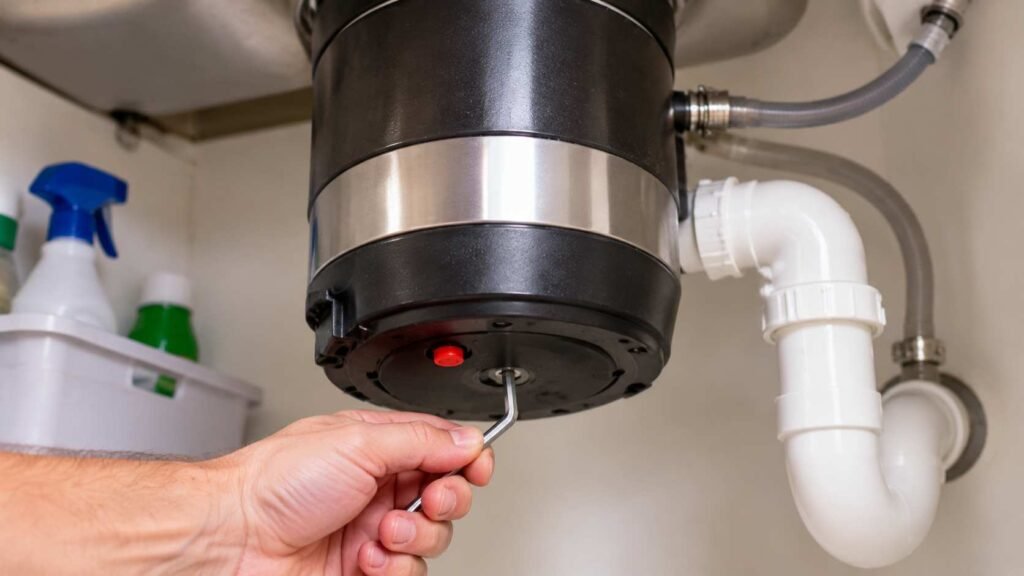
A humming sound usually means the turntable is jammed. Turn the power off, then use the hex key supplied with the unit in the socket at the centre of the base to work the turntable back and forth until it moves freely. Remove the object with tongs, press the reset button, then run cold water and turn the unit back on.
The disposer won’t start at all
Check that the power point is on, then press the red reset button on the underside of the unit. The motor has overload protection that trips if the unit is jammed or overworked. If it has an air switch, check the air tube is connected and not kinked.
The sink drains slowly
A slow sink usually means a blockage in the trap or the drain beyond the disposer, often caused by grease, fibrous scraps or grinding without enough water. Our blocked drain service can clear the drain without damaging the disposer or your pipes.
The disposer is leaking
Where the water appears tells you the likely cause:
- From the top, near the sink: the sink flange seal has failed and needs resealing
- From the side connections: the discharge pipe or dishwasher connection has loosened, or its seal has worn
- From the bottom of the unit: the internal seals have failed. This usually means the disposer needs replacing
Leaks under the sink can damage the cupboard floor without you noticing. Our leak detection service can find hidden leaks if you see swelling or water marks.
Bad smells from the disposer
Smells usually come from food stuck in the chamber or the splash guard. Run cold water and grind a handful of ice cubes, then some citrus peel. Clean under the rubber splash guard with a long-handled brush. If smells continue, there may be a partial blockage in the drain.
Repair or replace?
Disposers aren’t designed to be opened up and rebuilt at home. If the motor has failed, the unit leaks from the bottom, or it’s out of warranty and keeps jamming, replacement is usually the better option. If it’s still under warranty, contact InSinkErator before anyone works on it.
InSinkErator FAQs
What does an InSinkErator do?
An InSinkErator grinds food scraps into fine particles under your kitchen sink, and running water carries them away through the drain into the sewer.
Which InSinkErator model is best for my home?
The Model 46 suits light use, the Model 56 suits regular use in smaller households, the Model 66 suits larger families, and the Evolution models suit heavy use, quiet kitchens and buyers who want the longest warranty.
How much does InSinkErator installation cost?
It depends on the model, whether it’s a replacement or a first-time install, whether a power point and air switch hole are needed, and how much plumbing work is required. Ask a licensed plumber for a fixed, written quote.
Do I need a plumber to install an InSinkErator?
Yes. In NSW, connecting a disposer to your drainage is plumbing work that must be done by a licensed plumber. If a new power point is needed, that must be done by a licensed electrician.
Can I install an InSinkErator in Western Australia?
Water Corporation doesn’t allow food waste disposal units on facilities that discharge to its wastewater system. Check with your local water utility wherever you live.
What is an InSinkErator air switch?
It’s a button on the sink or benchtop that turns the disposer on and off by sending a pulse of air through a tube to the unit, so there are no electrical wires near the water.
Why is my InSinkErator humming but not working?
It’s usually jammed. Turn the power off, use the hex key in the base to free the turntable, remove any object with tongs, then press the reset button.
Can an InSinkErator go on a septic system?
It depends on your system. Extra food solids can affect septic tanks, so speak to your plumber and council before installing one.
Can I put chicken bones or fat in an InSinkErator?
Avoid fats, oils and grease, as they can set in your pipes. Check your model’s care booklet for what it can grind, and put large bones and fibrous waste in the bin.
How long does an InSinkErator last?
It depends on the model and how it’s used. Warranties range from 2 years for the Model 46 to 6 years for the Evolution 200, and units that are used correctly can last well beyond their warranty.
Book InSinkErator Installation or Repair with Radiant Plumbing
An InSinkErator can make kitchen clean-ups faster and cut down on smelly bins, as long as it’s the right model, installed properly and allowed in your area.
Radiant Plumbing Services installs, replaces and repairs food waste disposers across Greater Sydney. We’ll check your sink, drain and dishwasher setup, help you choose a model that suits your household, and give you a fixed, upfront quote before any work starts.
- $0 call-out fee
- Upfront, fixed quotes with no hidden fees
- Licensed and insured plumbers
- Available 24/7 through our emergency plumbing service
If your sink is leaking or overflowing right now, our water leak emergency guide and urgent leak repairs page explain what to do first. You can also read about leaking pipe repairs or kitchen tap repairs.
Call (02) 8866 1322 or book a plumber online, or explore our plumbing services.