
Quick answer: A dishwasher not draining is usually caused by a clogged filter, a blocked drain pump, a kinked or blocked drain hose, or a blockage in the kitchen sink drain the dishwasher empties into. Start by cleaning the filter and checking the hose. If the sink is also slow or gurgling, the problem is in your plumbing and needs a plumber. If the pump hums but won’t clear water, or your dishwasher shows a drain error code that won’t reset, it’s an appliance fault for a service technician.
You open the door at the end of a cycle and there’s a pool of grey, greasy water sitting in the bottom of the tub. Maybe the dishes are still dirty, maybe there’s a flashing light or an error code, and maybe the kitchen sink has started gurgling too. A dishwasher not draining is one of the most common kitchen problems in Sydney homes, and it’s frustrating because it stops the whole household routine.
The good news is that many drainage problems can be fixed in a few minutes with a sponge, a brush and a towel. Others point to a blocked kitchen drain or an installation problem that a plumber needs to sort out. A smaller number are appliance faults that need the manufacturer’s service team.
This guide walks you through why dishwashers stop draining, what you can safely check yourself, what the common error codes mean on brands like Bosch, Miele, Westinghouse, Smeg, Asko, Dishlex and Fisher & Paykel, and how to tell whether you need a plumber or an appliance technician.
How a Dishwasher Drains (and Where It Goes Wrong)
Knowing the path the water takes makes it much easier to find the blockage. When a cycle finishes, water travels through four stages:
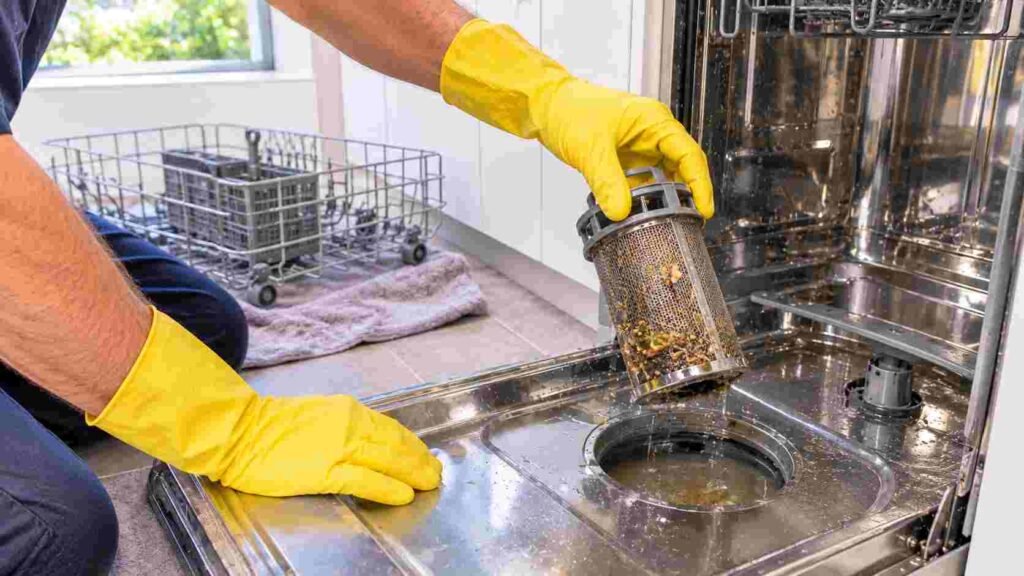
- The filter. Dirty water flows down through the filter assembly in the base of the tub. Most modern dishwashers have a coarse filter, a fine mesh filter and a flat filter plate that catch food scraps.
- The sump and drain pump. Under the filter is the sump, where water collects. The drain pump (a small electric pump with a spinning impeller) pushes the water out.
- The drain hose. A flexible hose carries the water from the pump, under or behind the kitchen cabinets, to the sink plumbing.
- Your kitchen drain. The hose connects to a spigot on the sink waste, a standpipe, or the inlet on a waste disposal unit. From there, water flows through the sink trap and into your home’s drainage pipes.
A blockage at any of these points will leave water sitting in the dishwasher. The first three are part of the appliance. The fourth is part of your home’s plumbing, and that’s where a plumber comes in.
Why Is My Dishwasher Not Draining? 8 Common Causes
1. A clogged filter
This is the most common cause by far. Food scraps, grease, seeds, labels and bits of broken glass build up in the filter until water can’t get through. If the water sitting in the tub is cloudy and full of food particles, start here. Many manufacturers recommend checking and rinsing the filter regularly, and more often if you don’t scrape plates before loading.
2. A blocked drain pump
Anything small enough to slip past the filter can jam the drain pump impeller. Common culprits include olive pits, cherry stones, small bones, toothpicks, glass shards and the plastic tabs from food packaging. A jammed pump often makes a humming or buzzing noise during the drain stage, but no water moves.
3. A kinked or crushed drain hose
The drain hose can be squashed when a dishwasher is pushed back into its cavity after cleaning or installation, or kinked behind the kickboard. Even a partial kink restricts flow enough to leave water behind.
4. A blocked drain hose
Grease and food residue can build up inside the hose over time, especially near the connection to the sink plumbing. The hose can also be blocked where it connects to the sink spigot if that spigot is coated in grease.
5. A blocked kitchen sink drain
Your dishwasher empties into the same pipe as your kitchen sink. If that pipe is partly blocked with fat, oil, grease and food scraps, the dishwasher can’t push water through it, and dirty water may even flow back into the dishwasher. Warning signs include a slow-draining sink, gurgling noises, bad smells from the sink and water backing up into the sink when the dishwasher drains.
6. A new waste disposal unit with the knockout plug still in
If you’ve just had a waste disposal unit (garbage disposal) installed and the dishwasher has stopped draining since, the plastic knockout plug in the disposal’s dishwasher inlet may not have been removed. The water has nowhere to go. This is a common installation mistake and a quick fix for a plumber.
7. A drain hose installed at the wrong height
Dishwasher manufacturers specify how high the drain hose needs to loop before it connects to the sink plumbing. If the hose sits too low, dirty water from the sink can siphon or flow back into the dishwasher. If it runs too high or too far, a weak pump may struggle to push water out. Problems that started after a new install or kitchen renovation often point here.
8. A failing drain pump or other appliance fault
If the filter, pump and hose are all clear but the pump makes no sound at all, or the dishwasher shows a drain error code that won’t go away, the pump motor, a non-return valve, a sensor or the control board may have failed. These are appliance repairs for the manufacturer’s service team or a qualified appliance technician.
How to Fix a Dishwasher That’s Not Draining: Step by Step
Work through these checks in order. Most of them take only a few minutes.
Safety first: Switch the dishwasher off at the wall and unplug it before you put your hands in the tub or remove any parts. Wear rubber gloves, as broken glass is often hiding in the sump. Never pour chemical drain cleaner into a dishwasher. It can damage seals and pumps, and leaves dangerous chemicals behind.
Step 1: Cancel and restart the drain
Some dishwashers stop mid-cycle if the door is opened, the power drops out or a program is interrupted. Check your manual for how to cancel or reset a cycle. Many models will run a drain when you cancel. If the water clears, run a short rinse cycle and watch to see whether the problem comes back.
Step 2: Remove the standing water
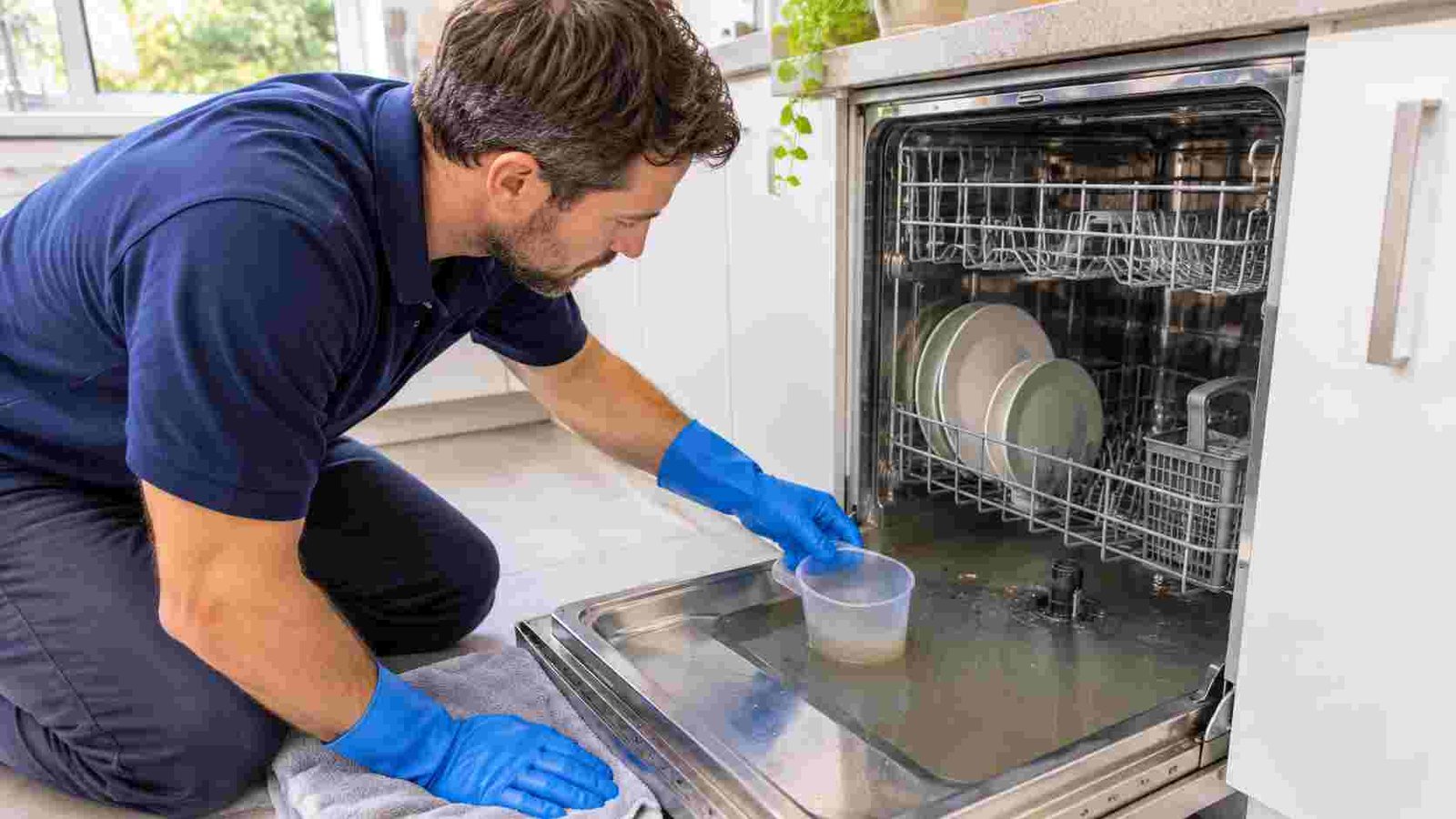
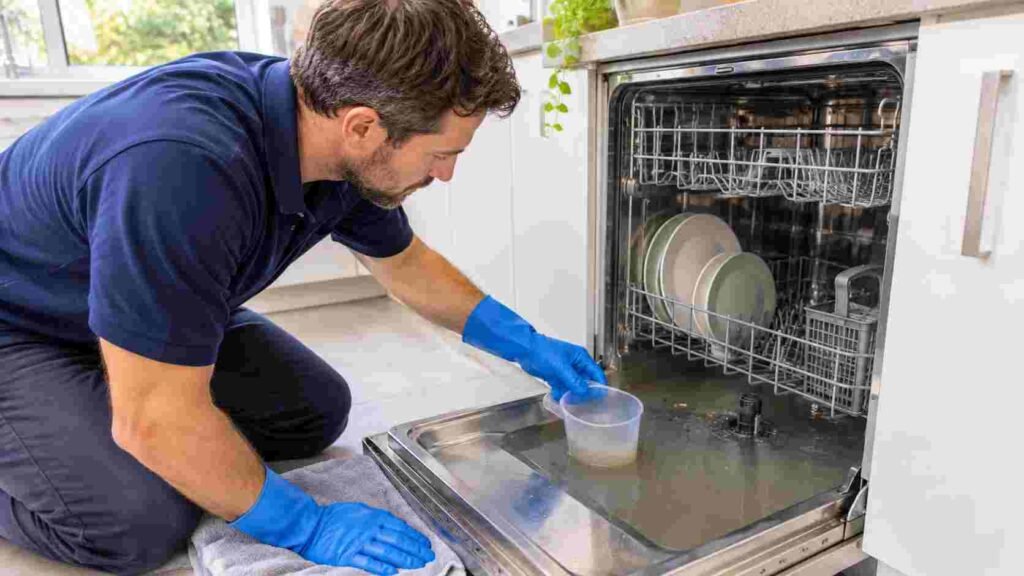
If water is still sitting in the tub, put towels on the floor and scoop it out with a cup or small container, then soak up the last bit with a sponge. This makes the filter and sump much easier to reach.
Step 3: Clean the filter
- Pull out the bottom basket.
- Twist and lift out the filter assembly (most turn anticlockwise).
- Separate the coarse filter, fine filter and filter plate if your model allows it.
- Rinse them under warm running water and scrub with a soft brush or old toothbrush to remove grease and debris.
- Check the filter for cracks or damage, as a damaged filter lets debris through to the pump.
- Refit the filter firmly until it locks into place. A filter that isn’t seated properly can trigger drain faults on some brands.
Step 4: Check the drain pump
With the filter out, look into the sump. Many dishwashers have a small pump cover inside the sump that can be removed by hand or with a spoon handle, depending on the model. Check your manual first. Carefully remove any glass, seeds, bones or plastic, then refit the cover so it sits flush. A loose or misaligned pump cover is a common cause of drain errors on its own.
Step 5: Check the drain hose
Look under the sink at the drain hose. Make sure it isn’t kinked, crushed or pinched by the cabinet or bin. If the hose runs behind the dishwasher, gently pull the dishwasher forward (it may be screwed to the benchtop) and check its full length. If you can disconnect the hose from the sink spigot easily, hold the end over a bucket and look or blow through it to check for blockages. Reconnect it firmly so it can’t leak.
Step 6: Check the kitchen sink
Run the sink tap for a minute. If the sink drains slowly, gurgles or smells, the blockage is likely in the sink waste or the pipes beyond it. Don’t use chemical drain cleaners, as they can damage pipes and seals and rarely clear a grease blockage properly. This is the point where a plumber should take over. Our blocked drain service uses the right equipment to clear grease and food build-up without damaging your pipes.
Step 7: Run a test cycle
Plug the dishwasher back in, turn on the power and run a short rinse or quick cycle with the dishwasher empty. Watch and listen during the drain stage:
- Water drains fully: the problem is solved. Keep the filter clean to stop it happening again.
- The pump hums but water stays: there’s still a blockage in the pump, hose or sink drain, or the pump is failing.
- No pump noise at all: the pump, its wiring or the control board may have failed. This is an appliance repair.
- The dishwasher drains but the sink fills with dirty water: the kitchen drain is blocked. Call a plumber.
Dishwasher Not Draining Properly vs Not Draining at All
The symptoms can point you to different causes:
| What you notice | Most likely cause | Who to call |
|---|---|---|
| A little clean water left in the sump | Normal on many models, as some water is meant to stay in the sump | No one |
| Cloudy water with food bits in the tub | Clogged filter | DIY: clean the filter |
| Pump hums, water doesn’t move | Jammed pump impeller or blocked hose | DIY check first, then appliance technician |
| No pump sound during drain | Failed drain pump, wiring or control board | Appliance technician |
| Sink gurgles, smells or drains slowly | Blocked kitchen drain | Plumber |
| Dirty water flows back into the dishwasher from the sink | Blocked sink drain or hose installed too low | Plumber |
| Problem started after a new disposal unit or kitchen install | Knockout plug left in, or hose connected incorrectly | Plumber |
| Water on the floor or a flood error code | Leak or anti-flood protection activated | Turn off and call for service |
A small amount of clean water in the sump below the filter is normal on many dishwashers, as it keeps the seals moist. It’s water above the filter, or dirty water with food in it, that signals a drain problem.
Brand Guide: Bosch, Miele, Westinghouse, Smeg and More
Most dishwashers drain the same way, but each brand displays drain problems differently. Codes vary between models and years, so always check your manual or the manufacturer’s support website for your exact model.
Bosch dishwasher not draining
Bosch dishwashers commonly show E24 when the dishwasher isn’t draining properly, often because of a blocked filter or a kinked or blocked drain hose, and E25 when the drain pump is blocked or the pump cover is loose. Bosch’s own guidance is to clean the filters, check the pump and its cover, and check the drain hose before calling service.
Miele dishwasher not draining
Miele dishwashers show F11 for a drainage fault, usually with water left in the wash cabinet. Miele’s troubleshooting steps include cleaning the filter combination, checking the drain pump, and making sure the non-return valve or pump cover is positioned correctly, depending on the model.
Westinghouse and Dishlex dishwashers not draining
Westinghouse and Dishlex are both part of the Electrolux group in Australia. Electrolux’s support guidance lists i20 (or two beeps, or two flashes on models without a display) as a drain problem. Start with the filter, then the drain hose and the sink connection.
Smeg dishwasher not draining
Many Smeg dishwashers show E6 when water can’t be pumped out. Smeg’s guidance points to a kinked or crushed drain hose, a blocked siphon or sink connection, or a blocked filter or drain pump.
Asko dishwasher not draining
Asko dishwashers with a text display may show a message such as “water outlet fault” or a drain pump fault. Asko’s manuals describe clearing the coarse and fine filters and unblocking the drainage pump before calling for service.
Fisher & Paykel dishwasher not draining
Fisher & Paykel DishDrawer dishwashers drain each drawer separately, so check whether one drawer or both are affected. Clean the filter in the affected drawer and check the drain hose. Be aware that an F1 code on many DishDrawer models means the flood protection has been activated, not a simple drain fault. Turn the dishwasher off and contact Fisher & Paykel service.
When it’s under warranty
If your dishwasher is new or still under warranty, contact the manufacturer before taking anything apart beyond the filter. Under Australian Consumer Law, you may also have rights beyond the warranty period. The ACCC explains these in its guide to repair, replace, refund rights, which also notes that businesses must cover the cost of collecting large installed appliances.
When the Problem Is Your Plumbing, Not the Dishwasher
Plenty of homeowners pay for an appliance repair, only to find the dishwasher was fine all along. The real problem was the drain it empties into. Call a plumber rather than an appliance technician if:
- Your kitchen sink drains slowly, gurgles or smells
- Dirty water comes up into the sink when the dishwasher drains
- Dirty sink water flows back into the dishwasher
- The problem started after a new waste disposal unit, sink, tap or benchtop was installed
- Other drains in the house are also slow, or there’s a bad smell from the drains outside
- The drain hose connection or sink spigot is leaking or loose
Grease is the biggest enemy of kitchen drains
Grease from dishwashers and sinks hardens as it cools in your pipes, and food scraps stick to it. Over time the pipe narrows until neither the sink nor the dishwasher can drain properly. Western Sydney University’s water expert notes that fats, oils and grease are among the worst culprits for blocked pipes and sewers. Scraping plates into the bin, wiping greasy pans with paper towel before washing, and using a sink strainer all help keep your kitchen drain clear.
What a plumber will do
A plumber can clear the sink trap and kitchen drain line, check that the drain hose connection and loop height meet the manufacturer’s instructions, remove a disposal unit’s knockout plug, and fix leaking spigots and connections. For stubborn blockages, high-pressure water jetting clears grease from the pipe walls, and a CCTV camera can show whether a tree root, broken pipe or sagging section is causing the problem further down the line.
In NSW, work on your drainage pipes must be done by a licensed plumber. You can check any tradesperson using the Service NSW licence check before work starts.
Dishwasher Water Not Draining? Watch for Leaks Too
A dishwasher that won’t drain can sometimes leak as well. Water can overflow at the door seal, or escape from a loose hose connection under the sink and soak into the cabinet floor and benchtop. Check under the sink and around the base of the dishwasher for swollen timber, damp patches or musty smells. If you suspect water has been leaking for a while, our leak detection service can find hidden leaks under cabinets and floors.
If water is spreading across the floor right now, turn off the dishwasher, close the tap under the sink that supplies it, and see our water leak emergency guide. Our urgent leak repairs page explains which leaks can’t wait.
How to Stop Your Dishwasher Drain Blocking Again
- Scrape plates into the bin before loading. The dishwasher filter isn’t designed to deal with bones, seeds or large food scraps.
- Clean the filter regularly. A quick rinse every week or two is easier than clearing a full blockage.
- Run the hot tap at the sink for a few seconds before starting the dishwasher, so it starts with hot water and grease doesn’t set as easily.
- Use the right detergent and dose. Too much detergent or the wrong product can leave residue that builds up in filters and hoses.
- Run an empty hot cycle with a dishwasher cleaner every month or two to clear grease from the sump and hose.
- Keep the sink drain clear. Use a sink strainer and keep fats and oils out of the sink.
- Check the hose after moving the dishwasher. Pushing it back into place can kink the hose.
- Use a licensed plumber for installation. Correct hose height and connection prevent backflow and drainage faults from day one.
Planning a new kitchen? Our kitchen renovation plumbing includes setting up dishwasher connections correctly, along with new sinks and kitchen tap repairs or replacements.
Dishwasher Not Draining FAQs
Why is my dishwasher not draining?
The most common causes are a clogged filter, a blocked drain pump, a kinked or blocked drain hose, and a blocked kitchen sink drain. Less often, the drain pump or control board has failed.
Is it normal to have water in the bottom of the dishwasher?
A small amount of clean water in the sump below the filter is normal on many dishwashers. Dirty water above the filter, or water with food scraps in it, means the dishwasher isn’t draining properly.
Can a blocked sink stop my dishwasher draining?
Yes. The dishwasher drains into the kitchen sink plumbing. If that pipe is blocked, the dishwasher can’t empty, and dirty water may back up into the sink or the dishwasher.
How do I reset my dishwasher after a drain error?
Most models reset by cancelling the program, or by turning the dishwasher off at the wall for a few minutes. Fix the cause first, such as cleaning the filter, or the error will come back. Check your manual for your model’s reset steps.
Should I call a plumber or an appliance technician?
Call a plumber if the sink is slow or gurgling, water backs up between the sink and dishwasher, or the problem started after new plumbing work. Call the manufacturer or an appliance technician if the plumbing is clear and the pump is silent or the error code won’t clear.
Can I use drain cleaner in my dishwasher?
No. Chemical drain cleaners can damage dishwasher seals, pumps and hoses, and may leave harmful residue. Clean the filter by hand and have a plumber clear any blockage in the sink drain.
Why does my dishwasher only drain sometimes?
An intermittent drain problem usually means a partial blockage in the filter, pump, hose or sink drain, or a pump that is starting to fail. Clean the filter and check the hose first.
How long should a dishwasher last before drain problems start?
It depends on the brand, how often it’s used and how well it’s maintained. Regular filter cleaning and a clear kitchen drain help a dishwasher drain reliably for many years.
What does a plumber charge to fix a dishwasher not draining?
It depends on the cause. Clearing a sink trap or reconnecting a hose is a small job, while clearing a grease blockage further down the drain takes more time and equipment. A good plumber will find the cause and give you a fixed quote first.
Get Your Kitchen Draining Again with Radiant Plumbing
Most dishwasher drainage problems start with a clogged filter, and that’s an easy fix. But if you’ve cleaned the filter and checked the hose and the water still won’t budge, or your kitchen sink is gurgling, slow or smelly, it’s time for a plumber.
Radiant Plumbing Services clears blocked kitchen drains and fixes dishwasher drain connections across Greater Sydney. We’ll find out whether the problem is your plumbing or the appliance, tell you straight, and give you a fixed, upfront quote before any work starts.
- $0 call-out fee
- Upfront, fixed quotes with no hidden fees
- Licensed and insured plumbers
- Available 24/7 through our emergency plumbing service
Call (02) 8866 1322 or book a plumber online. You can also explore our plumbing services or read about leaking pipe repairs.