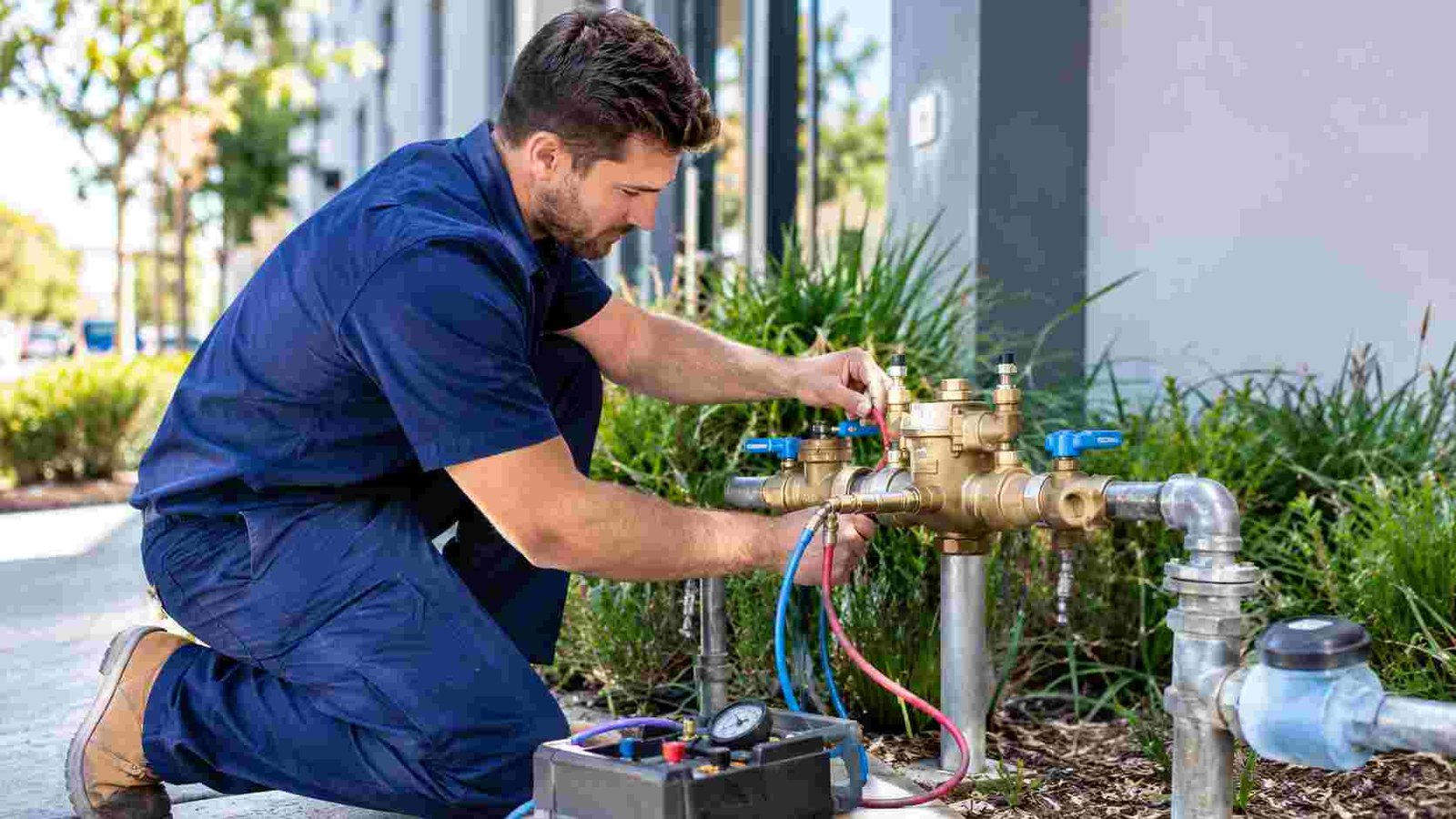
A backflow prevention device is a valve that stops used or dirty water flowing back into Sydney’s drinking water mains. Every property needs some protection, but medium and high hazard sites (cafés, medical suites, many strata blocks, sites with fire services or irrigation) need a testable device. In Sydney Water’s area, an accredited backflow plumber must assess the hazard rating, test the device when it goes in and every year after, and send the results to Sydney Water within 2 days. Cost depends on the device, pipe size, access and any repairs, so always ask for a fixed quote.
If a letter from Sydney Water has just landed on your desk asking about your “backflow device”, you’re not alone. Plenty of Sydney business owners, strata managers and landlords have never heard the word until that letter turns up. The good news is that the rules are fairly simple once someone explains them in plain English.
This guide covers what backflow is, why Sydney Water cares so much about it, how hazard ratings decide which device you need, what yearly testing involves, and what pushes the cost up or down. We’ll also share the faults we see most often on Sydney sites.
What Is Backflow and Why Does It Matter?
In a normal plumbing system, water only travels one way. It comes from the main in the street, through your meter, and out to your taps, toilets, coffee machines and hoses. Backflow is when that flow reverses and water from inside your property heads back towards the main.
That sounds harmless until you think about what is sitting in your pipes. A café has water mixed with cleaning chemicals. A dental clinic has equipment connected to the supply. A garden irrigation system has fertiliser and soil in its lines, and a fire sprinkler system may hold water that hasn’t moved in years. If any of that is drawn back into the shared main, it can end up in your neighbour’s glass of water.
Backflow happens in two ways. Backsiphonage occurs when pressure in the main suddenly drops, for example when a main bursts down the street or fire crews draw heavily from a hydrant. The Tweed Shire backflow policy describes it as what happens when supply pressure falls below atmospheric pressure. Water inside your property gets sucked backwards, a bit like drinking through a straw.
Backpressure is the opposite. The pressure inside your property becomes higher than the pressure in the main, so water is pushed back out. Booster pumps, boilers and pressurised tanks can all cause it.
Any link between your drinking water and a possible source of contamination is called a cross-connection. A hose left sitting in a bucket of chemicals is a simple example. Backflow prevention is the safety barrier that stops a cross-connection from becoming a public health problem.
What Is a Backflow Prevention Device?
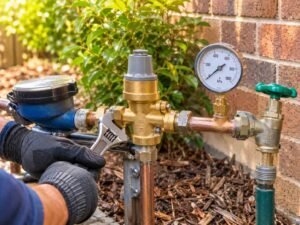
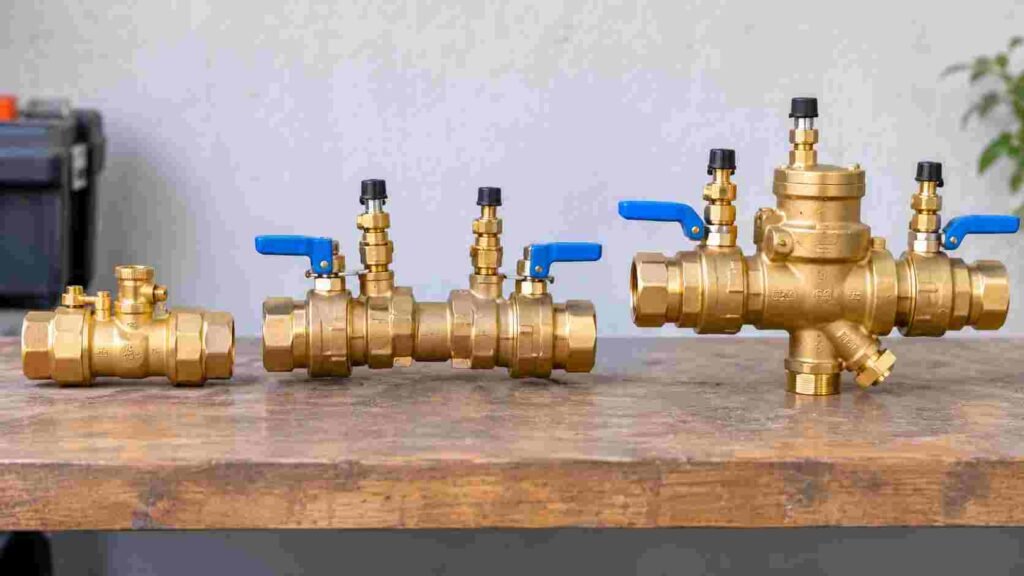
A backflow prevention device is a valve, or set of valves, that lets water into your property but not back out. Most use spring-loaded check valves that snap shut the moment water tries to reverse. Higher-risk models add a relief valve that dumps water to waste if something goes wrong, so contaminated water can’t reach the main.
You’ll hear it called a backflow prevention valve, a backflow preventer or just “the backflow”. What matters most is the type, because each one is built for a different level of risk.
The Main Device Types
| Device | Suits hazard rating | Testable? | How it works in simple terms |
|---|---|---|---|
| Dual check valve | Low | No | Two small one-way valves, often built into the water meter |
| Double check valve assembly | Medium | Yes | Two independent one-way valves with test points so a plumber can prove each one seals |
| Reduced pressure zone device (RPZD) | High | Yes | Two one-way valves with a relief valve between them that drains water away if pressure drops |
| Registered air gap or break tank | High | Inspected | A physical gap between the supply and the water below, so water cannot flow back |
Most low hazard homes already have protection without knowing it, because Sydney Water’s standard 20 mm and 25 mm meters have a dual check valve built in. Larger meters on low hazard sites need a separate non-testable device. The testable devices are where the yearly testing rules kick in.
How Hazard Ratings Decide What You Need
Every property connected to the mains has a hazard rating, and it’s the most important part of the whole backflow process. It decides which device you need and whether it must be tested each year.
The ratings come from the Australian Standard for water services, AS/NZS 3500.1. The Lower Murray Water policy sets out the same three definitions used across Australia. A high hazard has the potential to cause death. A medium hazard could endanger health. A low hazard is a nuisance that doesn’t endanger health or cause injury.
Here’s how that tends to play out on Sydney properties.
| Hazard rating | Typical Sydney properties | Device usually required |
|---|---|---|
| High | Hospitals, mortuaries, labs, chemical plants, car washes, sites using toxic chemicals | RPZD, registered air gap or registered break tank |
| Medium | Cafés and restaurants, dental and medical suites, childcare centres, strata blocks with pumps, sites with irrigation, fire services or mains-connected rainwater | Testable double check valve |
| Low | Most standard houses and small premises with no special equipment | Dual check valve, usually in the meter |
Treat this table as a general guide only. Two businesses that look the same from the street can get different ratings because of what’s plumbed in inside. A café that only makes coffee may rate differently from one with chemical dosing, a glass washer and a commercial dishwasher.
That’s why the rating has to be done on site. Sydney Water says an accredited backflow plumber must assess your hazard rating, and it should be reassessed whenever site activities change. Turn a warehouse into a commercial kitchen or add a big irrigation system, and your rating and device may need to change too.
Containment, Zone and Individual Protection Explained
This is the part most guides skip, and it confuses a lot of strata managers. Backflow protection works in layers, a bit like the locks on a building.
Containment protection is the device at your property boundary, usually just after the water meter. It protects Sydney Water’s main from everything inside your property, and it’s the device Sydney Water sends yearly reminders about. Zone protection sits inside the building and protects one section from another, such as residential floors above a ground-floor restaurant. Individual protection is fitted at a single fixture, like a chemical dispenser or dental chair.
The Greater Hume Council policy explains that individual or zone protection should be used together with containment protection, not instead of it. A backflow valve on your coffee machine doesn’t remove the need for a boundary device.
One detail trips people up. Sydney Water only registers containment devices on its backflow portal. Zone and individual devices are part of your building’s plumbing compliance, which Building Commission NSW regulates, so they aren’t lodged with Sydney Water. They still need to be the right type and kept in working order.
Who Needs Commercial Backflow Prevention in Sydney?
Every connection to the mains needs backflow protection, so the real question is whether you need a testable device. For most businesses, the answer is yes.
Commercial backflow prevention is most common in food businesses, medical and beauty clinics, childcare centres, schools, gyms with pools or spas, mechanics, car washes, laundromats and factories. Strata buildings often need it too, especially with booster pumps, shared hot water plant, fire hydrant systems or a commercial tenant downstairs.
Fire services deserve a special mention. Water in hydrant and sprinkler pipes can sit still for long periods, so these services almost always need their own testable device. Recycled water connections and rainwater tanks topped up from the mains are other common triggers.
Homes are usually low hazard, but not always. A house with a large irrigation system, a permanent pool top-up, a mains-connected rainwater tank or a home business using chemicals may need more than the valve in the meter. A renovation is a good time to sort it out while the pipes are open, whether it’s kitchen renovation plumbing or bathroom renovations.
Sydney Water Backflow Prevention Rules: What You Must Do
Here’s what Sydney Water backflow prevention rules ask of owners, in plain words. You must have the correct device for your hazard rating and keep it in good working order. You must hire an accredited backflow plumber to assess the hazard rating, install, test and register the device, test it every year, and send the results to Sydney Water within 2 days. All work must comply with the Plumbing Code of Australia.
Sydney Water keeps a register of testable devices and reminds you each year when the next test is due. Two different qualifications are involved, so here’s who does what.
| Task | Who can do it |
|---|---|
| Install a backflow containment device | A licensed plumber |
| Assess the site’s hazard rating | An accredited backflow plumber |
| Commission (first test) and register the device | An accredited backflow plumber |
| Annual test and lodge results with Sydney Water | An accredited backflow plumber |
| Repair a failed device | A licensed plumber, then retested by an accredited plumber |
Legal responsibility sits with the property owner. A tenant may run the business and an agent may book the work, but if the device isn’t tested, it’s the owner who’s on the hook. If you lease a commercial space, make sure the lease says who books and pays for yearly testing.
If a test date is missed, Sydney Water will send reminders and follow-up notices. Ignore them and the matter can escalate into compliance action, because the utility has a duty to protect the drinking water supply. The easy fix is to diarise the date and book a few weeks early. Strata committees should also keep a simple register of every device in the building, with its location, type, serial number and last test date.
What Makes a Plumber “Backflow Accredited”?
Not every plumber can test a backflow device. In NSW, a plumber needs a current licence plus extra backflow training. The NSW ESC backflow guide states that accreditation to commission, test and certify these devices is only issued to licensed plumbers holding a TAFE NSW Statement of Attainment in backflow prevention, or an equivalent. Sydney Water also asks for evidence of the national unit CPCPWT4022, Commission and maintain backflow prevention devices.
Before anyone works on your device, ask to see both their licence and their backflow accreditation. You can check any NSW licence in a minute with the Service NSW licence check.
When comparing backflow prevention specialists, ask whether they lodge results online with Sydney Water themselves, whether they’re insured, and whether repair quotes are fixed before work starts. Some testers hand you a paper form and leave the rest to you. Local experience also counts, because a plumber who knows older Inner West strata blocks, terrace conversions and new mixed-use buildings will spot problems faster.
How Backflow Prevention Testing Works
Backflow prevention testing is a hands-on check that proves every part of the device still seals and opens as it should. It’s done when the device is first installed, which is called commissioning, and then every 12 months.
What Happens on Test Day
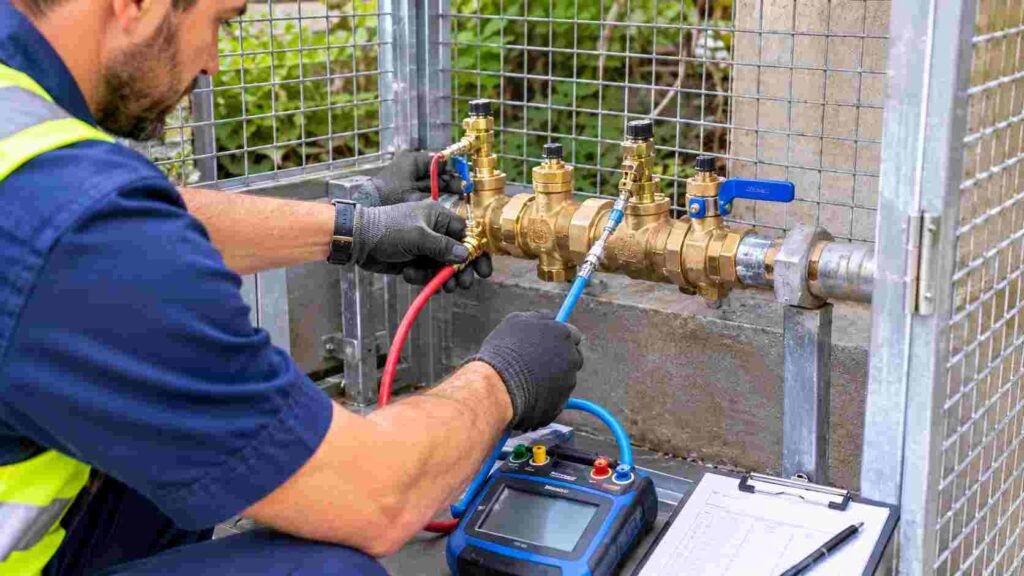
The plumber first checks that the device matches your hazard rating and is installed correctly, with the right clearances, isolation valves and drainage. Then they connect a calibrated test kit to the test points. The water is usually off for a short time, so if you run a busy business, book a quiet part of the day.
During the test, the plumber checks that each check valve holds tight against reverse pressure and, on an RPZD, that the relief valve opens at the right point. The test follows the field procedure in AS 2845.3, the Australian Standard for testing backflow devices. An RPZD takes longer than a double check valve because it has more parts to check.
If the device passes, the plumber records the readings and lodges the report with Sydney Water within 2 days, and you get a copy for your records. If it fails, the plumber explains why and quotes for the repair, then retests and lodges the passing result once it’s fixed.
To help things run smoothly, clear anything stored in the meter cage, have keys or car park fobs ready, and let staff or residents know the water will be off briefly. A strata block with domestic, fire and zone devices will naturally take longer than a single café.
Common Backflow Device Faults We See in Sydney
A handful of faults come up again and again on Sydney jobs, and they show why a device that looks fine can still fail its test.
The most common is a worn rubber seal or diaphragm. These parts flex every time water starts and stops, and over time they harden or crack. After a mains repair in your street, grit and rust can also lodge in the valve seats and stop them closing fully.
Another regular one is a dripping or discharging relief valve on an RPZD. A small drip often means a check valve isn’t sealing, while constant discharge can point to a bigger fault. Either way, the device needs attention.
We also find devices installed in the wrong spot, with no room for the test kit or no drainage under an RPZD, and wrong-type devices on sites whose use has changed. If an office became a medical clinic and nobody upgraded the device, the fix isn’t a repair. It’s a new device that matches the current rating. Banging pipes from fast-closing taps can also wear check valves over time, so worn fittings are worth fixing with our tap repairs service.
If testing points to a leak elsewhere, our leak detection service can find it without guesswork. If a failure has caused flooding or a burst, our 24/7 emergency plumbing team can help any time.
Backflow Prevention Valve Installation: What’s Involved
Backflow prevention valve installation starts with the hazard assessment. Once the rating is known, the plumber picks a device that suits the rating, your meter size and your water demand. A device that’s too small can cause a noticeable drop in water pressure, which no busy kitchen wants.
The device normally goes on the property side of the meter, close to the boundary. It needs isolation valves on both sides for testing and servicing, plus enough clearance for the test kit. An RPZD also needs safe drainage for its relief valve and shouldn’t sit in a below-ground pit, where floodwater could reach the relief port. Many owners add a lockable cage to protect brass devices from theft and vehicle damage.
After installation, an accredited plumber commissions the device by testing and registering it. Don’t leave a gap between the two. Hunter Water, for example, requires devices in its area to be commissioned within seven days of installation, and Sydney Water expects testing and registration as part of the same job.
If your pressure drops after a new device goes in, it may be undersized or partly blocked. One of our licensed Sydney plumbers can check it, and if old pipework is the real culprit, our guide to burst and leaking pipes explains your options.
How Much Does Backflow Prevention Cost in Sydney?
This is the question everyone asks first, and it’s where a single number can mislead you. A quick yearly test on an easy-to-reach double check valve is a very different job from installing a large RPZD on a fire service in a basement car park.
Rather than quote a figure that may not match your property, here’s what actually drives the price.
| Cost factor | Why it matters |
|---|---|
| Type of device | An RPZD costs more to buy and takes longer to test than a double check valve |
| Pipe and meter size | Larger devices for bigger services cost more and take more labour |
| Number of devices | Domestic, fire and zone devices are each tested separately |
| Access and location | Devices in tight cages, basements or busy areas take longer |
| New install or test only | Installation includes the device, fittings, isolation valves and labour |
| Repairs found during testing | Seals, springs or repair kits add parts and a retest |
| Enclosure or drainage | Cages and RPZD drainage add to an installation |
| Out-of-hours work | Testing after trading hours may cost more |
Two tips help keep costs down. Ask whether the quote includes lodging results with Sydney Water, so there’s no surprise extra. And if you have several devices, have them all tested in one visit.
Also weigh up the cost of doing nothing. An untested device brings repeated notices, and a faulty one can put customers, staff and neighbours at real risk. Contaminated water in a café or childcare centre is the kind of incident no business wants on its record.
At Radiant Plumbing Services, you get an upfront, fixed quote before any work starts, with no call-out fee. You can learn more about our team and how we work.
Simple Ways to Protect Your Water Between Tests
Your yearly test is the legal minimum, but a few easy habits keep your device and water in good shape all year.
Keep the area around the device clear and glance at it now and then. If an RPZD relief valve starts dripping, call a plumber rather than waiting for the next test. Never remove or bypass a backflow device, even if you suspect it’s causing low pressure, as that puts the supply at risk and creates a serious compliance problem.
Inside the property, avoid creating cross-connections. Don’t leave hoses in buckets, pools or drains, and fit hose tap vacuum breakers where chemicals or fertiliser are used outdoors. When you upgrade equipment like hot water systems, mention any backflow devices so the installer can confirm everything still complies. Slow drains near a cross-connection raise the risk too, so book blocked drain repairs early. For more maintenance tips, our plumbing blog and emergency pipe repair guide are worth a read.
Need Backflow Prevention Services in Sydney?
If you’ve received a Sydney Water letter, you’re opening a new business, or you’re simply not sure your property has the right device, Radiant Plumbing Services can help with backflow prevention services across Greater Sydney. We’ll check your setup, explain your options in plain English, and organise installation, testing and lodgement so you stay compliant without the stress.
Our plumbers are licensed and insured, and every job comes with an upfront fixed quote and no call-out fee. Call (02) 8866 1322 or book a plumber online to get your backflow sorted.
Frequently Asked Questions
Do all Sydney homes need a backflow prevention device?
Every property on the mains needs some backflow protection. Most standard Sydney homes are low hazard and already covered by the dual check valve in the water meter. Homes with large irrigation, permanent pool top-ups, mains-connected rainwater tanks or chemical-based home businesses may need more.
How often does a backflow prevention device need testing?
Testable devices on medium and high hazard sites are tested when first installed and then every 12 months. In Sydney Water’s area, results must be lodged within 2 days of each test.
Can any plumber do backflow prevention testing in Sydney?
No. Any licensed plumber can install a device, but only a licensed plumber who also holds backflow accreditation can assess hazard ratings and commission, test and register a containment device.
What is the difference between a dual check valve and a double check valve?
A dual check valve is a small, non-testable device for low hazard sites, often built into the meter. A double check valve assembly is a testable device for medium hazard sites, with test points so a plumber can prove each valve seals.
Why is water dripping from my backflow valve?
A drip from the relief port of an RPZD usually means a check valve isn’t sealing properly, often because of a worn seal or debris. The device is doing its job, but it needs an accredited plumber to inspect and repair it.