A toilet gurgles when air is forced back up through the water in the pan. That happens when something stops air and water moving freely through the drain: a partial blockage in the toilet, a blockage in a drain it shares with the shower or laundry, a blocked vent, or a blockage in the main sewer. A single gurgle after a big flush is usually harmless. Regular gurgling, gurgling when other fixtures drain, or gurgling with sewage smells means a blockage is building and should be cleared before it overflows.
A gurgling toilet is the plumbing equivalent of a warning light. The sound itself does no damage, but it tells you that air and water are fighting for space somewhere in your drains. Left alone, the restriction that causes it usually gets worse until the toilet or another fixture blocks or overflows.
The useful part is that the gurgle tells you a lot about where the problem is. A toilet that gurgles only when you flush it points to a different cause than one that gurgles when the washing machine empties, or one that only gurgles in heavy rain. This guide explains what each pattern means, the four main causes, what you can safely check yourself and when to call a plumber. The licensed team at Radiant Plumbing wrote it from the gurgling toilets and drains we diagnose across Sydney every week.
Toilet gurgling and not sure why? Radiant Plumbing can find the cause with a camera and clear it properly, with a $0 call-out fee and a fixed price before we start. Call (02) 8866 1322.
What Actually Makes a Toilet Gurgle?
A toilet gurgles when air is pushed or pulled through the water sitting in its trap. Every toilet pan has a curved trap moulded into the porcelain. The water sitting in that curve forms a seal that stops sewer gas from entering your bathroom. Normally, when you flush or when water drains elsewhere in the house, air moves freely through the pipes and the vent, and the trap seal stays still.
When something restricts that flow, the air has nowhere to go. Water draining down a partly blocked pipe pushes the air in front of it, and that air escapes the easiest way it can: back up through the toilet’s trap water, which you hear as a gurgle and see as bubbles. The opposite can also happen. Water rushing down a pipe with no air supply creates suction, called negative pressure, that pulls water out of the toilet trap. That’s why the water level in the bowl sometimes drops or wobbles after you hear the gurgle.
WaterSafe, the UK’s approved plumbing contractors’ scheme, describes the three main culprits the same way: a partial drain blockage, a blocked vent pipe, or a blocked main sewer line. In Sydney there is a fourth: stormwater entering the sewer in heavy rain. Working out which one you have starts with when the gurgle happens.
What Is Your Gurgle Telling You?
The timing of the gurgle is the best clue to its cause. Use this table to narrow it down before you do anything else.
| When the toilet gurgles | Most likely cause | How urgent |
| Only when you flush it, and the bowl drains slowly | Partial blockage in the toilet trap or pan outlet | Fix within a day or two |
| When the shower, bath or basin drains | Partial blockage in the shared branch drain | Fix within a few days |
| When the washing machine empties | Blockage or undersized drain in the shared line, or a venting issue | Fix within a few days |
| By itself, randomly, with no water running | Vent problem, or pressure changes from a blockage further down | Book a plumber |
| Only in heavy rain | Stormwater getting into the sewer, or a sewer overloaded by rain | Book a plumber; urgent if the gully overflows |
| With sewage smells or water at the overflow relief gully | Main sewer line blocked | Urgent: stop using water and call a plumber |
| Neighbours are gurgling too | Possible blockage in Sydney Water’s sewer main | Call Sydney Water on 13 20 90 |
If you’re not sure, run the one-flush test. Flush the toilet once while someone watches the shower drain and another fixture. If water rises or bubbles in the shower, the blockage is in a shared drain, not the toilet.
Is a Partial Blockage in the Toilet Making It Gurgle?
A toilet that gurgles when you flush it and drains slowly afterwards usually has a partial blockage in its own trap. Toilet paper, a wipe or a small object has lodged in the curve of the porcelain trap. Water still squeezes past, but not fast enough, so the flush pushes air back up through the bowl.
This is the most common cause, and the easiest to fix. A flange plunger or a toilet auger clears most trap blockages in a few minutes. If the toilet is blocked rather than just gurgling, stop flushing and turn off the isolation tap behind it first. Our step-by-step guide on how to fix a blocked toilet explains each method for Australian dual-flush toilets, including what not to use.
One warning sign is a toilet that keeps gurgling even after plunging seems to work. That usually means the blockage is still there, or something solid is stuck that lets water through but catches paper. An auger, or a plumber, will find it.
Why Does the Toilet Gurgle When the Shower or Washing Machine Drains?
A toilet that gurgles when another fixture drains is telling you the blockage is in a pipe they share. In most homes, the toilet, shower, basin and floor waste all join a branch drain before it reaches the main sewer line. When that branch is partly blocked, water from the shower backs up slightly and pushes air into the toilet’s trap, which bubbles and gurgles even though nobody flushed it.
When the Shower or Bath Drains
Hair, soap scum and sludge from the shower build up in the shared drain over months. The shower drains slower, then the toilet starts gurgling as the shower empties, and eventually water rises through the floor waste. Clearing the shower trap and grate helps, but if the toilet still gurgles, the build-up is further down and needs a drain machine. Our guide on how to clean a drain covers what you can clear yourself in the shower, basin and floor waste.
When the Washing Machine Empties
A washing machine pumps out a large volume of water very quickly, often 50 litres or more in a minute or two. If the laundry drain is partly blocked with lint, or the vent can’t supply enough air, that surge pushes air through every connected trap, including the toilet. A lint filter on the washing machine hose reduces build-up, but repeated gurgling on every wash means the laundry drain needs clearing or checking.
Can a Blocked Vent Pipe Make the Toilet Gurgle?
Yes. A blocked or faulty vent is the most overlooked cause of a gurgling toilet. Every drainage system needs air to flow freely. Most Sydney homes have at least one vent pipe that runs from the drains up through the roof, letting air in and sewer gas out above head height. When water drains, air flows in through the vent instead of being sucked through the toilet’s trap.
If the vent is blocked, the system can’t breathe. Water draining anywhere in the house pulls air from the easiest place it can, which is often the toilet trap. The result is gurgling, a wobbling bowl water level and sometimes a sewer smell when the trap seal is pulled too low. Vents block with leaves, birds’ nests, wasp mud and, occasionally, debris from roof work.
Some homes and apartments use an air admittance valve (AAV) instead of, or as well as, a roof vent. It’s a one-way valve, usually under a sink or in a cupboard, that opens to let air in when water drains and closes to keep sewer gas out. AAVs can stick or wear out over time. Building Commission NSW publishes an advisory note on how AAVs must be installed (published May 2021, updated July 2025), because a wrongly placed or unsuitable valve is a common source of venting problems.
Don’t climb on the roof to check a vent. Vent pipes are often on steep or fragile roofs, and the problem can be inside the pipe where you can’t see it. A plumber can clear or camera the vent and test or replace an AAV safely.
Does a Gurgling Toilet Mean the Sewer Is Blocked?
It can. If the toilet gurgles along with other fixtures, the drains are slow throughout the house, or you smell sewage outside, the blockage may be in the main sewer line that carries all your wastewater to the street. In older Sydney homes, the usual cause is tree roots growing into the joints of clay pipes. Grease build-up and wipes are the next most common.
The quickest check is the overflow relief gully. That’s the round grate outside, usually near the laundry or kitchen wall, set slightly below floor level. If the sewer backs up, sewage overflows there instead of inside your home. Water sitting in the gully or bubbling out of it means the main line is blocked. Stop using water in the house and call a plumber.
You’re responsible for the sewer pipes on your property up to the Sydney Water junction near the boundary. If the gully overflows when no one is using water, or your neighbours have the same problem, the fault may be in Sydney Water’s main, so call Sydney Water on 13 20 90. Our guide to the common causes of blocked drains in Sydney explains why main lines block and how to prevent it.
Why Does the Toilet Only Gurgle When It Rains?
A toilet that only gurgles in heavy rain usually means stormwater is getting into the sewer. The sewer and the stormwater system are meant to be completely separate. When rain finds its way into the sewer, through cracked pipes, a low overflow relief gully, or a downpipe illegally connected to a sewer pipe, the sewer fills faster than it can drain. The rising water pushes air back through every trap, and the toilet gurgles.
Hornsby Shire Council states plainly that “stormwater pipes are not allowed to be connected to the sewerage system”, because the extra water causes sewage overflows into homes and waterways. If your toilet gurgles mostly in storms, a plumber can check for broken pipes letting groundwater in, test whether any downpipes run into the sewer, and raise a gully that sits too low. If your yard also floods or pits overflow in the same storms, our guide to drainage problems in Sydney covers the stormwater side.
What Can You Safely Check Yourself?
You can narrow down the cause in about ten minutes without tools beyond a torch. Work through these checks in order:
- Flush the toilet once and watch the bowl. Does it drain slowly, or does the water level wobble?
- Run the shower for a minute, then the basin and laundry tub. Does the toilet gurgle or the shower water rise?
- Look at the overflow relief gully outside. Is there water in it, or a sewage smell?
- Check under the sinks for an air admittance valve. Does it look cracked or loose?
- Ask your neighbours whether their drains are slow or gurgling too.
If only the toilet is affected, try a flange plunger. If several fixtures are affected, the gully has water in it, or the gurgling is constant, don’t keep plunging. The blockage is beyond the toilet, and plunging can push sewage up through the shower or floor waste. Avoid chemical drain cleaners: they rarely clear a shared-drain or sewer blockage, and they make the job dangerous for the plumber.
When Is a Gurgling Toilet an Emergency?
A gurgling toilet becomes urgent when sewage is about to come into the house. Treat it as an emergency if water or sewage is coming out of the overflow relief gully, a floor waste or the shower, if you can smell sewage inside, or if the toilet or another fixture is overflowing. Stop using all water, including the dishwasher and washing machine, and call a plumber straight away.
| Situation | What to do |
| Occasional gurgle after a big flush, toilet drains normally | Monitor; plunge if it gets slower |
| Gurgle on every flush, slow draining | Plunge or use an auger; call a plumber if it persists |
| Gurgling when other fixtures drain | Book a plumber this week |
| Constant gurgling, sewer smell inside | Book a plumber within a day |
| Water or sewage at the gully, floor waste or shower | Stop using water; call a plumber now |
If sewage is overflowing inside, our emergency plumbing team is available 24/7 across Sydney.
How Does a Plumber Find the Cause?
A plumber starts with the same checks you can do, then confirms the cause inside the pipe. A drain machine or high-pressure jetter is run from the overflow relief gully or an inspection opening to clear the line, and a CCTV camera is then fed through the pipe to show exactly what caused the blockage: roots, a crack, a sag or built-up grease. The vent and any air admittance valves are checked at the same time.
The camera matters because gurgling often comes back after a simple clear if the real cause, such as roots at a broken joint, isn’t fixed. It also gives you footage to keep for your records, your landlord or an insurance claim. Our guide to CCTV drain inspection costs in Sydney explains what’s included and what it costs.
How Much Does It Cost To Fix a Gurgling Toilet?
The cost depends on where the problem is. These are typical Sydney prices during business hours, consistent with our drain cost guides:
| Fix | Typical Sydney price |
| Clearing a toilet blockage with an auger | $180 to $400 |
| Clearing a shared branch drain or main sewer line (electric eel) | $250 to $600 |
| High-pressure jetting for grease or roots | $350 to $900 |
| CCTV camera inspection added to a clear | $200 to $450 |
| Clearing a vent or replacing an air admittance valve | Quoted on site |
| After hours, weekends and public holidays | 1.5 to 2 times the standard rate |
Most gurgling toilets are fixed with a single clear of the right pipe. For a full breakdown of clearing prices and what pushes them up, see our guide to drain cleaning costs in Sydney.
What if the Camera Finds a Broken Pipe?
If the camera shows cracks, root-filled joints or a collapsed section, clearing alone won’t stop the gurgling for long. Roots grow back, and cracks keep catching paper and grease. The permanent fix is to repair the pipe.
For one damaged section, a patch reline seals the crack from the inside without digging, typically $2,500 to $5,000. For several defects along the line, a full reline creates a new pipe inside the old one, usually $5,000 to $12,000 for a house sewer. A collapsed or badly sagging pipe has to be dug up and replaced. Our guide to pipe relining costs in Sydney compares relining with digging up the pipe.
How Do You Stop Your Toilet Gurgling Again?
Most gurgling comes back for the same reasons it started, so prevention is mostly about what goes down the drains. Flush only toilet paper and human waste, and use the full flush for solids. Keep fat, oil and food scraps out of the kitchen sink, fit hair catchers in showers and a lint filter on the washing machine. Never use boiling water or caustic cleaners, which damage PVC pipes and seals.
Outside, keep the overflow relief gully clear and visible, and make sure it sits above the surrounding ground. If you have large trees near an old clay sewer line, a camera check every two to three years catches root growth before it causes a blockage. Our guide to PVC sewer pipe maintenance sets out a simple care schedule for your drains.
Who Pays To Fix a Gurgling Toilet?
The property owner pays for problems in the private drains and vents on their land, and Sydney Water is responsible for its sewer main. In NSW rentals, drain and toilet problems are generally the landlord’s responsibility to fix, unless the tenant caused the blockage, for example by flushing wipes. In strata buildings, shared drains and vent stacks are usually common property, so the owners corporation organises and pays for the repair. Report it to your strata manager first. Our guide to plumber costs in Sydney explains call-out fees and hourly rates if you’re paying for the visit yourself.
Gurgling Toilet FAQs
Is a gurgling toilet serious?
An occasional gurgle after a big flush is usually harmless. Frequent gurgling, gurgling when other fixtures drain, or gurgling with sewage smells means a blockage or venting problem is building. It should be fixed before it causes an overflow, especially if the overflow relief gully has water in it.
Why does my toilet gurgle when I take a shower?
The toilet and shower usually share a branch drain. If that drain is partly blocked with hair and soap, water from the shower pushes air back through the toilet’s trap and it gurgles. Clearing the shower trap may help, but a plumber usually needs to clear the shared drain with a machine.
Why does my toilet gurgle by itself?
A toilet that gurgles with no water running usually has a venting problem, or a blockage further down the line that is changing the air pressure in the pipes. Water draining in another unit or a neighbour’s home can trigger it in strata buildings. A plumber can check the vent and camera the drain.
Can I fix a gurgling toilet myself?
You can clear a partial blockage in the toilet itself with a flange plunger or toilet auger. If several fixtures are affected, the gully has water in it or the gurgling continues after plunging, the problem is in a shared drain, the vent or the sewer, which needs a licensed plumber with the right equipment.
Why does my toilet gurgle when it rains?
Gurgling only in heavy rain usually means stormwater is getting into the sewer, through cracked pipes, a low overflow relief gully or a downpipe connected to a sewer pipe. The sewer fills faster than it drains and pushes air back through the toilet. A plumber can find and fix where the rainwater enters.
Will a gurgling toilet fix itself?
Rarely. A small paper blockage can sometimes soften and pass, but the gurgling usually comes back or gets worse because the underlying restriction is still there. Waiting increases the risk of an overflow, so it’s better to plunge a toilet-only gurgle early and call a plumber if it involves other fixtures.
How much does it cost to fix a gurgling toilet?
In Sydney, clearing a toilet blockage usually costs $180 to $400, and clearing a shared drain or main sewer line $250 to $600 during business hours. A camera inspection adds $200 to $450. Vent repairs are quoted on site, and after-hours work typically costs 1.5 to 2 times the standard rate.
Who is responsible for a gurgling toilet in a strata building?
In strata buildings, drains and vent stacks shared by more than one lot are usually common property, so the owners corporation organises and pays for the repair. A blockage in your own toilet or the pipe serving only your unit may be your responsibility. Check your by-laws and contact your strata manager first.
Get a Gurgling Toilet Fixed by Radiant Plumbing
A gurgling toilet is an early warning that air and water can’t move freely through your drains. Use the timing of the gurgle to narrow down the cause, clear a toilet-only blockage yourself with a plunger, and call a plumber when the gurgle involves other fixtures, the vent, the overflow relief gully or heavy rain.
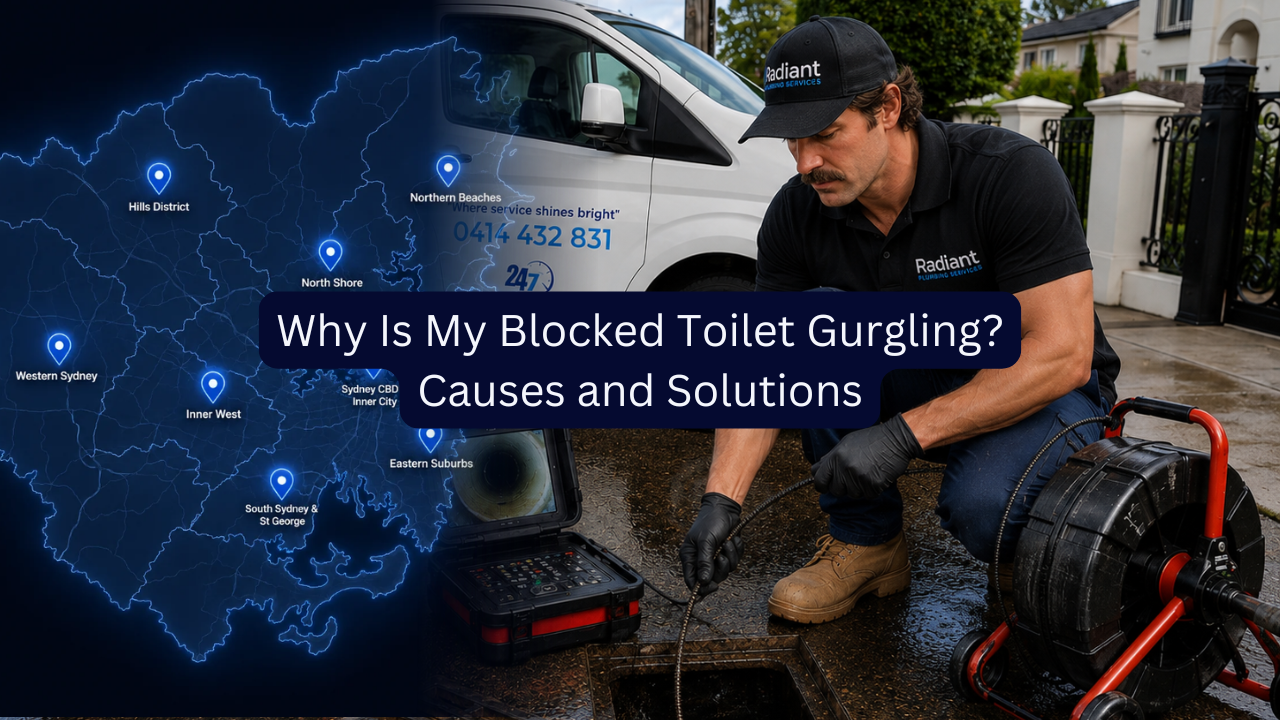
Radiant Plumbing diagnoses and fixes gurgling toilets and drains across Sydney, from the Inner West and Eastern Suburbs to the North Shore, Hills District, Western Sydney and St George. We clear the line, show you the camera footage and give you a fixed price for any repair before we start.
Need a gurgling toilet fixed? Call Radiant Plumbing on (02) 8866 1322, request a quote online, or see our toilet repair services.