PVC sewer pipes last for decades when you keep heat, harsh chemicals, fats, wipes and roots out of them. Use hot tap water, never boiling water, because PVC drainage is rated for 60°C continuous and softens at about 80°C. Fit strainers, keep the overflow relief gully clear, and book a camera inspection every 2 to 3 years if trees grow near the line.
PVC (polyvinyl chloride) is the standard material for house sewer pipes in Australia. Most Sydney homes built or replumbed since the 1980s have a PVC sewer running from the house to the Sydney Water junction near the boundary. PVC doesn’t rust or corrode, but it can still be damaged by heat, chemicals, poor installation, ground movement and tree roots entering at the joints.
This guide explains how long PVC sewer pipes last, what shortens their life, what to do and avoid, a simple care schedule and the warning signs of a problem. It also covers where DIY stops in NSW. The licensed drainage team at Radiant Plumbing wrote it from the PVC, clay and cast-iron sewer lines we clear, inspect and repair across Sydney.
Not sure what condition your sewer is in? Radiant Plumbing can inspect it with a camera and tell you exactly what it needs. Call (02) 8866 1322.
How Long Do PVC Sewer Pipes Last?
Correctly installed PVC sewer pipes are expected to last more than 100 years. That expectation comes from Australian research on pipes that have already been in the ground for decades.
- Ipswich Water commissioned tests on PVC sewer pipes exhumed after up to 25 years of service. The pipes had no failures, showed no material deterioration, and their rubber-ring joints still met current performance specifications (Whittle and Tennakoon, Plastic Pipes Conference, 2004).
- Based on that work, the Australian PVC pipe industry extended service life expectations for PVC sewer pipe beyond 100 years (Whittle and Tennakoon, 2005, as cited in Trenchless Technology, 2013).
The pipe material itself rarely fails. Problems come from the joints, the installation, the ground around the pipe and what goes down it. Good maintenance targets those weak points.
What Shortens the Life of a PVC Sewer Pipe?
Six things damage or block PVC sewer pipes: heat, harsh chemicals, fats and wipes, tree roots at joints, ground movement and poor installation.
Does Boiling Water Damage PVC Pipes?
Yes, repeated boiling water can damage PVC pipes. PVC-U drainage has a recommended maximum continuous operating temperature of 60°C, and PVC fittings soften at about 80°C (Holman Industries, AS/NZS 1260:2017 scope of use). Boiling water is 100°C. Pouring it down the drain regularly can soften solvent-welded joints and distort fittings near the sink. Use hot tap water instead. Hot water systems in Australia store water at 60°C or more and deliver about 50°C at bathroom outlets, which suits PVC.
Are Chemical Drain Cleaners Safe for PVC?
Caustic and acid drain cleaners are not a good choice for PVC sewers. They generate heat as they react, sit in the pipe when they fail to clear a blockage, and can damage rubber-ring seals and older fittings. They also make the job dangerous for the plumber who has to clear the drain afterwards. Enzyme (bio) cleaners digest organic build-up slowly and are safe for PVC.
How Do Fats, Oils and Wipes Affect PVC Sewers?
Fats, oils and grease (FOG) cool and set inside the pipe, narrowing it until food, hair and wipes catch on the build-up. Wet wipes, including those labelled “flushable”, don’t break down like toilet paper and bind with grease into solid blockages. The smooth inside of PVC slows this build-up but doesn’t stop it. Our guide to the common causes of blocked drains in Sydney covers what goes wrong in Sydney homes.
Can Tree Roots Get Into PVC Pipes?
Tree roots can enter PVC pipes, but only through joints, not through the pipe wall. Australian research found that where PVC sewers choked with roots, the usual cause was incorrect assembly of the joint (Trenchless Technology, 2013). Solvent-cement joints resist roots well. Rubber-ring joints resist roots when correctly assembled and are used where the ground moves. Root resistance of joints is tested under AS 5055.
How Does Ground Movement Affect PVC Sewers?
Reactive clay soils, which are common across Western Sydney, swell when wet and shrink when dry. That movement can pull joints apart or create a low spot (a belly) where waste settles. Heavy vehicles driving over shallow pipes can also crush or deform them. Pipes under driveways need the right stiffness class and depth of cover, set by AS/NZS 3500.2.
What Should You Do and Avoid With PVC Sewer Pipes?
These are the habits that keep PVC sewers clear:
| Do | Don’t |
| Run hot tap water and detergent through kitchen sinks weekly | Pour boiling water down the drain |
| Scrape plates into the bin; collect cooled fat in a jar | Pour fats, oils or grease down the sink |
| Use strainers in sinks, showers and the laundry tub | Flush wet wipes, nappies, cotton buds or sanitary items |
| Use enzyme cleaners for smells and slow drains | Use caustic or acid drain cleaners |
| Keep the overflow relief gully grate clear and visible | Cover the gully with soil, pavers or decking |
| Plant trees well away from the sewer line | Plant large-rooted trees over the drain |
| Call Before You Dig Australia before digging | Drive heavy vehicles over shallow drain lines |
Most single-fixture blockages can be cleared safely at home. Our guide on how to clean a drain explains the right methods for each drain in the house.
How Often Should PVC Sewer Pipes Be Maintained?
PVC sewer pipes need light weekly and monthly care at home, a yearly check of access points, and a professional inspection every few years if trees or past blockages put them at risk.
| How often | What to do | Who does it |
| Weekly | Clean shower and sink strainers | Homeowner |
| Monthly | Hot tap water and detergent flush in the kitchen sink; enzyme cleaner in drains prone to smells | Homeowner |
| Every 6 months | Check the overflow relief gully grate is clear and sits below floor level | Homeowner |
| Yearly | Check inspection openings are accessible and capped; look for wet patches over the line | Homeowner |
| Every 2 to 3 years | Camera inspection if large trees grow near the line or it has blocked before | Licensed plumber |
| As needed | High-pressure jetting to remove grease or root growth | Licensed plumber |
Maintenance jetting costs far less than an emergency clear. Our guide to drain cleaning costs in Sydney lists typical prices.
Where Are Your Sewer Access Points?
Your sewer has three access points worth knowing: the overflow relief gully, inspection openings and the boundary trap.
- Overflow relief gully (ORG): a round grate outside, usually near the kitchen or laundry. It sits at least 150 mm below the lowest fixture inside (and 75 mm above the surrounding ground) so that if the sewer backs up, sewage overflows outside rather than into your home. Keep it clear and never raise the ground around it.
- Inspection openings (IOs): capped pipes, often at ground level, that give a plumber access for clearing and cameras. Keep the caps on and the area accessible.
- Boundary trap: found in many older Sydney homes near the front boundary, with a raised access shaft. Newer homes often don’t have one.
Opening sewer access points exposes you to sewer gas and bacteria. Leave clearing and camera work at these points to a plumber.
Do PVC Sewer Pipes Need Camera Inspections?
PVC sewer pipes need a camera inspection every 2 to 3 years when large trees grow nearby or the line has blocked before. A camera shows root growth at joints, sags and separated joints before they cause a blockage. For a sound PVC line with no trees nearby, inspect only if symptoms appear. Our guide to CCTV drain inspection costs in Sydney explains prices and what the report should include.
What Are the Warning Signs of a PVC Sewer Problem?
The early warning signs of a PVC sewer problem are:
- several fixtures draining slowly at the same time
- gurgling from toilets or floor wastes when other fixtures drain
- sewage smells inside or in the yard
- water rising in the overflow relief gully or a downstairs shower
- wet patches, sinking ground or a lush green strip over the line
- the same drain blocking again within weeks
Gurgling is often the first sign of a partial blockage further down the line. Our guide on why a blocked toilet gurgles explains what it means.
How Is PVC Different From Clay and Fibrolite Sewer Pipes?
PVC needs less maintenance than older materials because it has fewer joints, a smoother bore and no corrosion. Many Sydney homes still have older pipes on part of the line.
| Material | Common in | Typical problems |
| PVC | Homes built or replumbed since the 1980s | Heat damage, poorly assembled joints, ground movement |
| Earthenware (vitrified clay) | Homes built before about the 1970s | Roots at many short joints, cracks, displaced joints |
| Fibrolite (asbestos cement) | Some post-war homes | Cracking; contains asbestos, so must never be cut or broken by unlicensed people |
| Cast iron | Under older buildings and in vent stacks | Rust, scale build-up, cracks |
Many homes have a mix, for example a PVC line from the house joining an old clay line near the boundary. The older section usually needs the most attention. Our guide to sewer repairs and damage covers replacing or repairing older lines.
Can You Repair Your Own PVC Sewer Pipe in NSW?
No. In NSW, sanitary drainage work, including cutting, joining and replacing sewer pipes, must be done by a licensed plumber and drainer. Homeowners can clean strainers, clear a sink trap and keep access points clear. Repairs also involve trench safety, sewer gas and asbestos risks in older lines, and the work must comply with the Plumbing Code of Australia and AS/NZS 3500.2.
Licensed work also protects you: it comes with a compliance certificate, insurance and a warranty. Our guide to plumber costs in Sydney explains how call-out fees and hourly rates work.
What Happens When Maintenance Isn’t Enough?
When a camera shows roots, cracks or separated joints, the fix depends on the damage:
- Grease or light roots: high-pressure jetting clears the pipe back to the wall.
- One damaged joint or crack: a patch reline seals it from the inside, without digging.
- Several defects along the line: a full reline creates a new pipe inside the old one.
- Collapsed pipe or severe sag: the section is dug up and replaced with new PVC.
Our guide to pipe relining costs in Sydney compares relining with digging and lists typical prices.
PVC Sewer Pipe FAQs
How long do PVC sewer pipes last?
Correctly installed PVC sewer pipes are expected to last more than 100 years. Pipes exhumed after 25 years showed no material deterioration.
Can you pour boiling water down PVC pipes?
No. PVC drainage is rated for 60°C continuous and softens at about 80°C. Use hot tap water.
How often should sewer pipes be cleaned?
Most PVC sewers only need professional jetting when a camera or symptoms show build-up. Lines near large trees benefit from a camera check every 2 to 3 years.
Can tree roots break PVC pipes?
Roots enter PVC through joints, not the pipe wall, usually where a joint was poorly assembled or has moved. Once inside, roots can block the pipe and push joints further apart.
Are root killers safe for PVC sewer pipes?
Some root treatment products are designed for PVC, but many contain chemicals that can harm waterways and septic systems. Follow the label exactly, or ask a plumber, who can cut roots out and recommend a longer-term fix.
Who is responsible for my sewer pipe?
You’re responsible for the sewer pipes on your property up to the Sydney Water junction. Sydney Water owns the junction and main; call 13 20 90 if the fault is on its side.
Keep Your PVC Sewer Healthy With Radiant Plumbing
PVC sewer pipes last for decades when you keep heat, harsh chemicals, fats, wipes and roots out of them. Use hot tap water, fit strainers, keep the overflow relief gully clear and book a camera inspection every 2 to 3 years if trees grow near the line. Leave repairs and joint work to a licensed plumber.
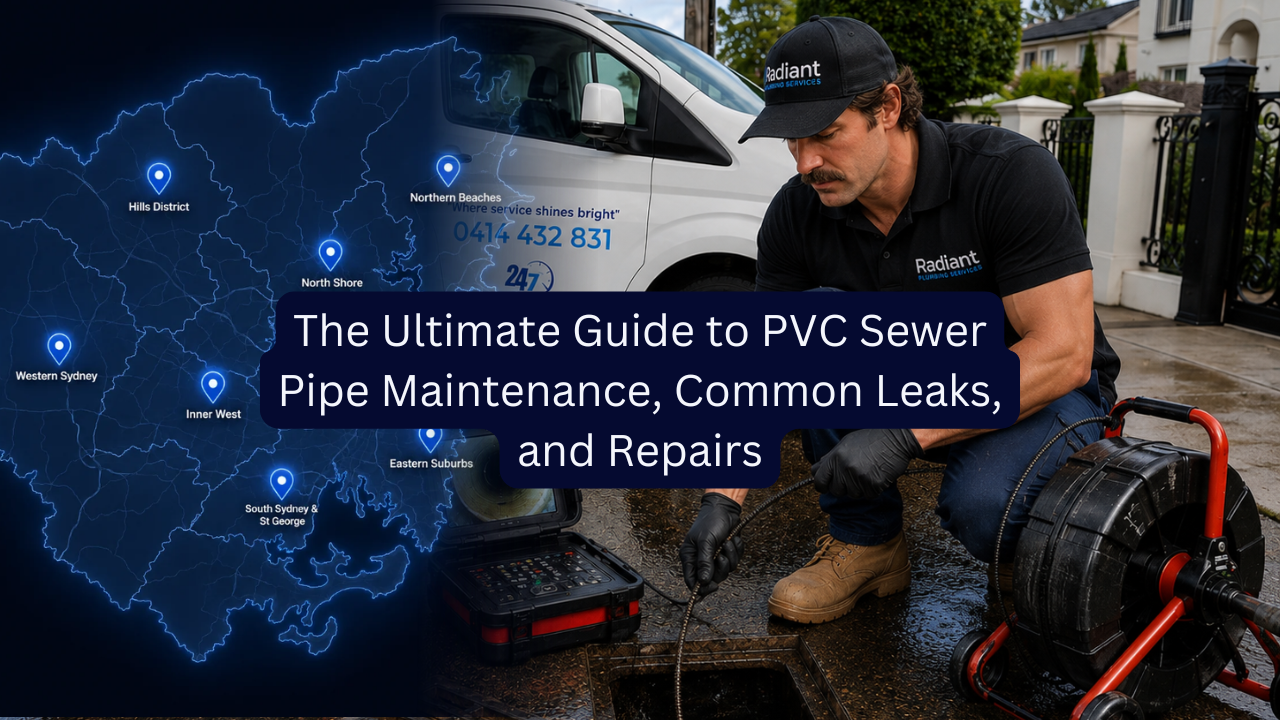
Radiant Plumbing inspects, clears and repairs PVC, clay and cast-iron sewer lines across Sydney, from the Inner West and Eastern Suburbs to the North Shore, Hills District, Western Sydney and St George. [Google rating and review count: add the real figures here.] If sewage is overflowing at your gully or inside the house, call our emergency plumbing team now.
Book a sewer check: call Radiant Plumbing on (02) 8866 1322, request a quote online, or see our blocked drain services.