
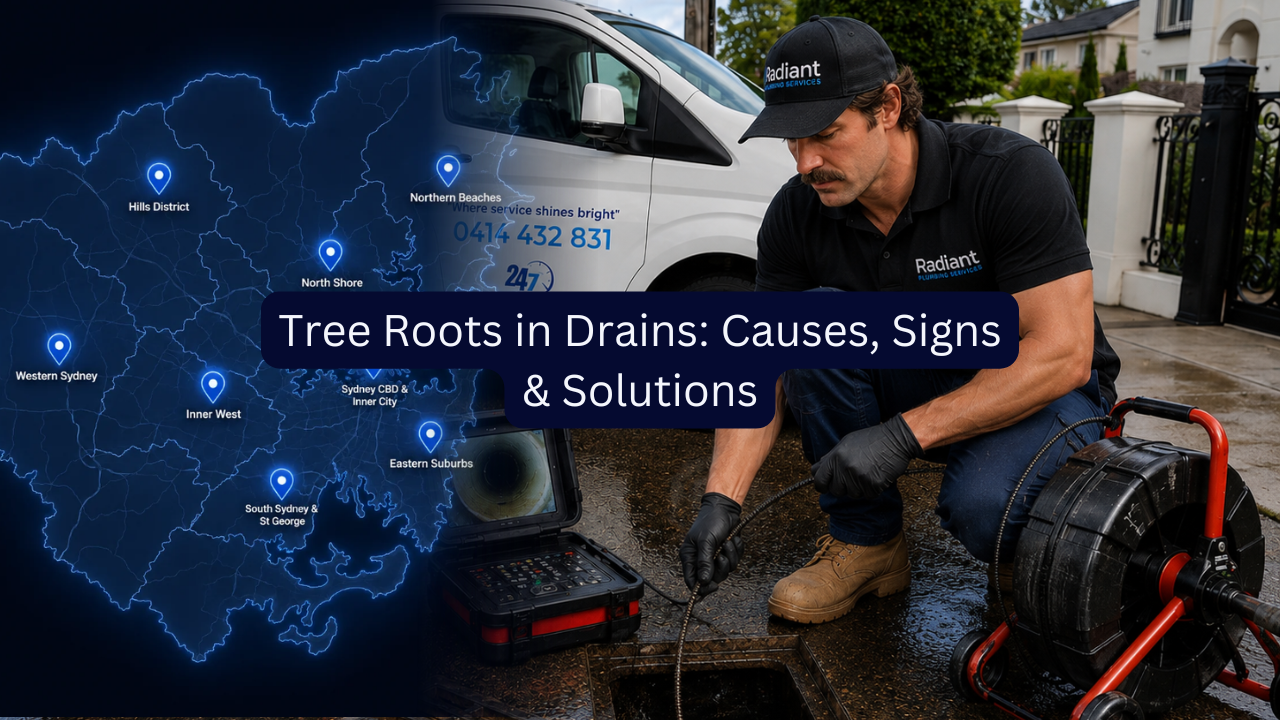
Tree roots get into drains through small cracks and loose joints, then grow into a mass that catches waste and blocks the pipe. A plumber confirms them with a CCTV camera, cuts or jets them out, then seals the pipe with relining or replaces the damaged section so they can’t grow back.
Tree roots in drains are one of the most common causes of blocked sewer pipes in Sydney, especially in established suburbs with mature trees and older clay pipework. Roots are remarkably good at finding water. Once they find a way into your pipes, they keep growing, and a minor slow drain can become a full sewer blockage or even a collapsed pipe.
This guide explains how tree roots get into pipes, the warning signs to look for, how professional root removal works, whether root killers actually help, who is responsible when the tree belongs to a neighbour or the council, and how to stop roots coming back. It’s written by Radiant Plumbing, a licensed Sydney plumbing team that clears and repairs root-damaged drains across the city.
Roots blocking your drains? Radiant Plumbing finds root intrusion with CCTV cameras and clears it with root cutting and hydro jetting, with a $0 call-out fee across Sydney. Call (02) 8866 1322 or see our blocked drain service.
How Do Tree Roots Get Into Pipes?
Tree roots get into pipes by finding gaps, not by breaking through solid pipe. Roots naturally grow towards moisture and nutrients, and sewer and stormwater pipes give off both. Warm, damp air escaping from even a hairline crack or a slightly loose joint is enough to attract fine root hairs.
Once a root tip finds its way in, it has everything it needs: water, nutrients from wastewater and protection from drying out. It grows quickly inside the pipe, branching into a dense, hair-like mass that spreads along the pipe. As the roots thicken, they widen the gap they came through, letting more roots in and sometimes cracking or displacing the pipe.
Why Older Sydney Homes Are Most at Risk
Many homes built in Sydney before the 1980s have clay (terracotta) sewer pipes. These were laid in short lengths joined with mortar or rubber rings, which means a joint every metre or so. Over decades, mortar crumbles, rubber rings perish and joints shift with ground movement, giving roots an easy way in. Modern PVC pipes have fewer, better-sealed joints and are far more resistant, though roots can still enter through damaged or poorly installed sections.
Trees Most Likely To Cause Problems
Any tree or large shrub can send roots into a pipe, but species with aggressive, water-seeking roots cause the most trouble. In Sydney, these commonly include figs, willows, poplars, camphor laurels, liquidambars and many eucalypts. Even trees planted several metres from a sewer line can reach it, because roots often spread well beyond the tree’s canopy.
Signs of Tree Roots Blocking Drains
Tree roots blocking drains usually cause problems slowly, with warning signs that build up over weeks or months.
The most common early sign is slow drainage throughout the house, particularly in toilets, showers and floor wastes, because roots usually block the main sewer line rather than a single fixture. Gurgling sounds from drains or toilets as water pushes past the root mass are another clue; our guide on why a blocked toilet gurgles explains this in more detail. Repeat blockages that return weeks after being cleared are a strong indicator of roots, because clearing the pipe without dealing with the roots only buys time.
Outside the house, watch for sewage smells in the yard, unusually lush or green patches of grass along the line of the sewer pipe, soggy ground, and water or waste coming out of the overflow relief gully. Sinkholes or depressions in the lawn can indicate a pipe that has cracked or collapsed. For a wider look at what else causes drains to block, see our guide to the common causes of blocked drains.
How Professional Tree Root Drain Removal Works
Professional tree root drain removal has two goals: clear the roots that are blocking the pipe now, and stop them from coming back. A licensed plumber will usually work through these steps.
Step 1: Confirm Roots With a CCTV Drain Camera
A small waterproof camera is fed into the pipe through an access point to show exactly where the roots are, how much of the pipe they fill and what condition the pipe is in. This matters because it decides the right fix. A few fine roots at one joint need a very different solution from a pipe that is cracked along its length. Our CCTV drain inspection cost guide explains what this involves.
Step 2: Cut or Jet the Roots Out
Clearing blocked drains of tree roots is usually done with one of two tools. A mechanical root cutter, sometimes called an electric eel, uses a rotating blade on a long flexible cable to cut through the root mass. High-pressure water jetting, or hydro jetting, uses a powerful jet of water to blast roots, grease and debris off the pipe walls. Jetting tends to leave the pipe cleaner, which slows regrowth, and many plumbers use both: cutting first, then jetting.
Step 3: Fix the Entry Point
Cutting roots out clears the blockage, but the cracks and joints they came through are still there. Unless those are sealed, roots usually grow back within months. That’s where a longer-term repair comes in.
Pipe Relining
Pipe relining seals the pipe from the inside without digging. A flexible liner coated in resin is inserted into the cleaned pipe and cured in place, creating a smooth, jointless new pipe within the old one. Because there are no joints or cracks left, roots can’t get back in. It’s often the best option when the pipe is still in reasonable shape and digging would mean disturbing driveways, paving or gardens. Our pipe relining cost guide covers what it typically costs.
Excavation and Pipe Replacement
If a pipe has collapsed, is badly displaced or is too damaged to reline, the section needs to be dug up and replaced, usually with modern PVC. This is more disruptive but gives you brand-new pipe. Our guide to sewer repairs and damage explains when replacement is needed.
| Method | How it works | How long it lasts | Best for |
| Root cutting | Rotating blade cuts through roots | Months; roots regrow | Quick clearing of a blockage |
| Hydro jetting | High-pressure water clears roots and residue | Months to a year or more | Thorough cleaning before repair |
| Root killer (after clearing) | Chemical slows regrowth | Months; needs repeating | Maintenance between clearings |
| Pipe relining | Resin liner seals cracks and joints | Long term, decades | Pipes in fair condition |
| Excavation and replacement | Damaged section dug up and replaced | Long term, decades | Collapsed or badly damaged pipes |
Sick of roots coming back? Radiant Plumbing can clear root-blocked drains and recommend a permanent fix such as relining or replacement, based on what the camera shows. Call (02) 8866 1322 or book online.
What Dissolves Tree Roots in Sewer Lines? Do Root Killers Work?
Root killers can slow regrowth, but they don’t dissolve a root mass that’s already blocking a pipe, and they don’t fix the crack the roots came through. Most root killers for drains sold in hardware stores use copper sulphate crystals or foaming herbicides. Poured or flushed into the drain, they kill the roots they touch, which then slowly break down.
The problem is that a blocked pipe is full of roots, so the chemical can’t reach most of them, and dead roots still have to be cleared out. Root killers work best as maintenance after a plumber has cleared the pipe, used every few months to discourage new growth while you plan a permanent repair.
How To Kill Tree Roots in Pipes Safely
If you choose to use a root killer, follow the product label exactly, wear gloves and eye protection, and don’t mix it with other drain chemicals. Avoid using it in a fully blocked drain, where it will sit in the pipe instead of reaching the roots. Bear in mind that strong chemicals can harm the tree itself and nearby plants, and some can damage older pipes or septic systems. If a tree is protected under your council’s tree management rules, check before doing anything that could kill or damage it.
Home Remedies vs Professional Clearing
You’ll find home remedies online, such as rock salt or baking soda and vinegar. These may have a minor effect on fine roots near the surface, but they won’t clear an established root blockage. General drain cleaning tips, such as those in our guide on how to clean a drain, help with grease and hair, but roots need cutting, jetting and ideally a permanent repair.
Tree Roots in Pipes: Who Is Responsible?
Who is responsible for tree roots in pipes depends on whose pipe it is and whose tree it is.
Your Tree, Your Pipe
If the tree and the damaged pipe are both on your property, the repair is your responsibility. In Sydney, property owners are responsible for the private sewer pipes on their land, up to the point where they connect to Sydney Water’s sewer main.
Sydney Water’s Pipe
If a licensed plumber finds that roots have blocked Sydney Water’s sewer main rather than your private pipe, Sydney Water is responsible for clearing it. Report it on 13 20 90, 24/7. Source: Sydney Water, general plumbing information
A Neighbour’s Tree
If roots from a neighbour’s tree have damaged your pipes, start by talking with your neighbour and sharing the CCTV footage or plumber’s report. Many disputes are settled informally or through a free community justice centre mediation. In NSW, the Trees (Disputes Between Neighbours) Act 2006 allows owners to apply to the Land and Environment Court about damage caused by a tree on adjoining land. Getting a written plumber’s report that shows the roots and their source is important if it comes to that.
A Council or Street Tree
If roots are from a street tree on the nature strip, contact your local council. Councils have their own processes for assessing tree-related damage, and they may inspect the tree or the pipe. Don’t remove or heavily prune a council tree yourself.
How Much Does Tree Root Removal Cost?
The cost of tree root removal depends on how bad the blockage is, how easy the pipe is to reach and which repair is needed. A one-off root clearing with a cutter or jetter usually costs a few hundred dollars, while a CCTV inspection is often added to diagnose the cause. Permanent fixes such as relining or excavation cost considerably more, but they stop repeat call-outs.
For current typical prices, see our drain cleaning costs guide, CCTV drain inspection costs and pipe relining costs. For general plumber rates and call-out fees, our guide to plumber cost in Sydney explains how pricing works.
How To Stop Tree Roots From Growing Into Pipes
The most reliable way to stop tree roots from growing into pipes is to remove the gaps they use. Relining or replacing old clay pipes with jointless or well-sealed modern pipe solves the problem at its source. If that isn’t possible yet, scheduled jetting every 6 to 12 months, combined with a root killer between clearings, can keep roots under control.
Think carefully about planting, too. Keep large, water-hungry trees well away from sewer and stormwater lines, and ask your plumber to mark where your pipes run before you plant. Root barriers, which are vertical sheets installed in the ground between a tree and a pipe, can redirect root growth in some situations.
Finally, keep an eye on early warning signs, and have your drains checked if you’ve had roots before or own an older home with large trees. A regular home plumbing inspection can include a drain check, and if you’re buying, a pre-purchase plumbing inspection with a camera can reveal root problems before you commit. Modern PVC lines need less attention but still benefit from care; see our guide to PVC sewer pipe maintenance. Stormwater pipes can be affected as well; our guide to drainage problems in Sydney covers those.
Tree Roots in Drains FAQs
How fast do tree roots grow back in sewer pipes?
After clearing, roots often grow back within 6 to 12 months, sometimes faster in warm, wet weather. They keep returning until the cracks or joints they came through are sealed or the pipe is replaced.
Can tree roots break pipes?
Roots usually enter through existing cracks and joints rather than breaking solid pipe. Once inside, however, they can widen cracks, displace joints and contribute to a pipe collapsing over time.
Will removing the tree fix the problem?
Not on its own. Roots already in the pipe stay there and still need to be cleared, and the cracked pipe still needs repairing. Removing a tree may also need council approval.
H3: Is a root-blocked sewer an emergency?
It can be. If sewage is backing up inside the house or overflowing in the yard, treat it as urgent and call an emergency plumber.
Does home insurance cover tree root damage?
Many Australian home insurance policies exclude damage caused by tree roots, or treat it as gradual damage. Some cover resulting water damage. Check your Product Disclosure Statement for the exact wording.
Get Tree Roots Cleared With Radiant Plumbing
Tree roots in drains don’t go away on their own. They keep growing, causing slow drains, repeat blockages and eventually cracked or collapsed pipes. The right fix is to confirm the problem with a camera, clear the roots properly, and then seal or replace the pipe so they can’t get back in.
Radiant Plumbing is a licensed Sydney plumbing team that finds and clears tree roots in drains and sewer lines, using CCTV cameras, root cutters and hydro jetting, and recommends long-term repairs such as pipe relining where needed. We service homes across the CBD, Eastern Suburbs, Inner West, North Shore, Northern Beaches, Hills District, Western Sydney and the St George area, with a $0 call-out fee and fixed upfront pricing.
Tree roots in your drains? Call Radiant Plumbing on (02) 8866 1322, 24/7, or request a call-back online. Learn more about our blocked drain services in Sydney.